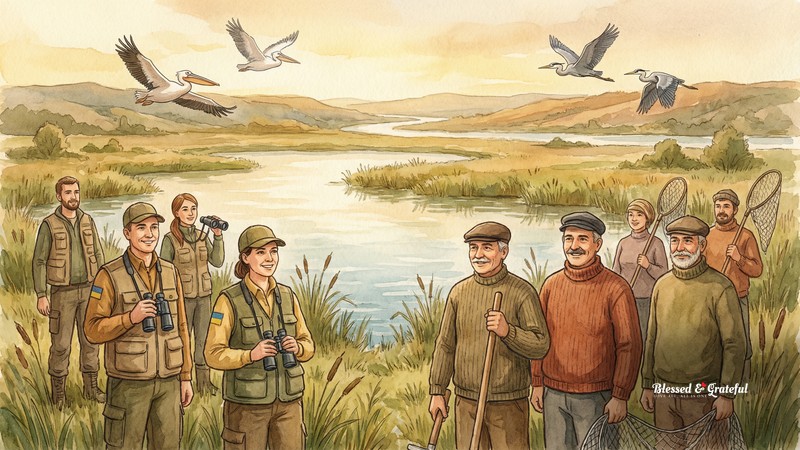
There is a lake in southwestern Ukraine that spent decades forgetting what it was. Lake Kartal, once a thriving wetland fed by the great Danube River, had been cut off — dammed, drained, silted shut — until the water barely moved and the birds stopped coming.
Then a small team decided to help it remember. Over the past six years, Rewilding Ukraine and the Izmail Department of Water Resources have been quietly undoing the damage. They removed dams. They cleared silted channels. They installed sluice pipes. And in the most recent phase — just completed — they reopened over five kilometres of the Luzarza channel at the lake's western end, boosting the flow of Danube water into Lake Kartal by forty percent.
The results have been swift and startling. More than 18,000 hectares of land and water now breathe with renewed life. Water circulates through an eleven-kilometre loop connecting Lake Kartal and Lake Kahul. Wetland plants are returning. Fish have begun migrating in from the Danube. Pelicans, herons, and white-tailed eagles are reappearing overhead. For local fishermen and farming families, this is not abstract conservation — it is their livelihoods returning.
What makes this story extraordinary is its context. This restoration is happening in Ukraine — a country at war. While conflict occupies the east, in the southwestern corner of the Danube Delta, people are still choosing to build, to restore, to invest in the future of a landscape they love. Rewilding Ukraine officer Oleg Dyakov and his colleagues work with heavy machinery and hope in equal measure, restoring approximately 450 hectares of floodplain in this latest phase alone.
In 2026, the work continues — more wetlands, more forests, even reintroductions of deer and eagle owls. The river is remembering. And the people who helped it are proving something quiet and fierce: that even in the hardest times, care for the living world does not stop.