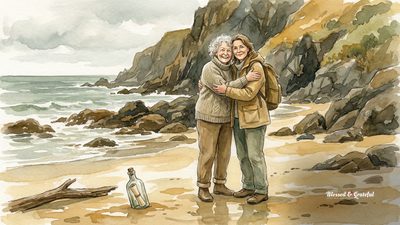
In 1997, Erika Boyero was working as a bartender on a cruise ship somewhere off the coast of Norway. She was young, and she did what young people sometimes do when the ocean seems to invite it — she wrote messages on paper, tucked them into bottles, and dropped them overboard. She didn’t know where they would go. That was part of it.
Four years later and halfway around the world, Diane Charles was taking her usual morning walk along the beach at Stanley, Tasmania, when she spotted something in the surf. Covered in barnacles, riding the slow waves toward her, was a bottle. Inside: a note written in Spanish. With help from her brother’s dictionary and a local scholar, Charles worked through the message word by word. It read: “Life has taught me all is possible, receive love and success second to this.” And at the bottom: a name, a Colombian address, a fax number.
Charles sent a fax to Colombia. Boyero’s father answered, and delivered the news to his daughter: “Hey, you received a fax from Australia.” That was the beginning. For 25 years, the two women wrote and called each other — celebrating births, marking moves, simply checking in. Boyero eventually relocated to Germany. The friendship outlasted addresses, outlasted time zones, outlasted every ordinary reason for such a connection to thin and disappear. It didn’t.
In March 2026, Boyero found herself in Kuala Lumpur and made a call. Would Charles be home? She would. Boyero flew to Tasmania — the farthest destination a message in a bottle has ever had to travel — and the two women embraced like people who know exactly what they have. Their first stop was Tatlows beach, the same shore where Charles had bent down to pick up a barnacled bottle years before. Their second was the Stanley Discovery Museum, where Boyero’s original note now lives behind glass as part of a local exhibition. What she wrote to the ocean 29 years ago is now considered worth keeping. Which, of course, it was all along.