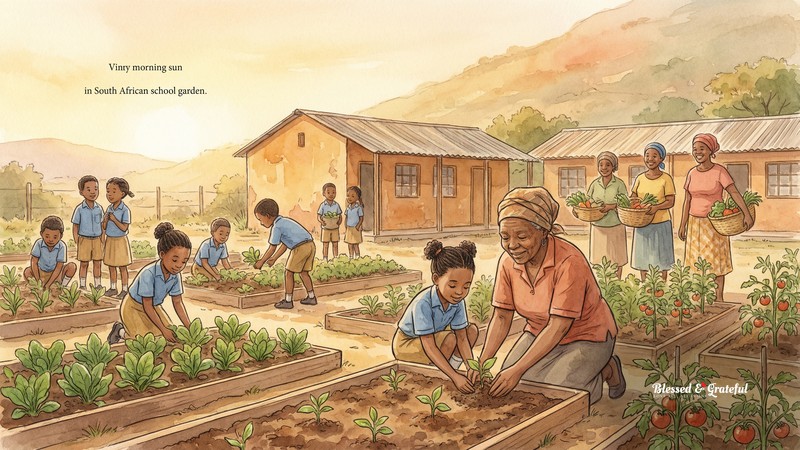
There is a particular kind of quiet that settles over a school garden in the early morning — the rows of spinach catching the light, the learners arriving to check what has come up overnight. In Mogale City, west of Johannesburg, that quiet has been getting louder lately. Schools are harvesting. And the harvest doesn't stay inside the school gates.
In a partnership between the Mogale City Business Committee and the Gauteng West Department of Basic Education, ten schools have received tools, training, and a simple invitation: grow food, and share what you grow. Khululekani Primary School in Swaneville and Mohlakeng Primary School in Randfontein were among the first to put their hands in the soil — and within months, produce from their gardens was making its way to nearby clinics and families in the community around them.
The program is part of something larger. Across South Africa, a quiet movement of school and community food gardens has been building for years — accelerated now by organizations like Food & Trees for Africa and Shoprite's Act For Change programme, which have invested in gardens that are teaching children where food comes from while simultaneously creating work for adults. At the Umthambeka Drop-in Centre in Thembisa, a garden established to support vulnerable households now employs three people. In the Free State, a women's cooperative called Modulaqhowa grows vegetable seedlings and fruit trees, partnering with schools and early childhood centers — introducing the smallest learners to the idea that a seed in the ground is a kind of promise.
"School gardens are a powerful tool for change," said Gideon Phiri, chairperson of the Mogale City Business Committee. "They not only address food security challenges but also equip learners with practical skills that can benefit them and their communities for years to come." Nearly 23% of South African children live in severe food poverty. The gardens can't fix everything — but they are fixing something real: the sight of a child who has eaten, concentrating, learning, growing up to know that the earth can be counted on.
What stays with you about these gardens is not the statistics. It's the image of a school plot that feeds a clinic. A cooperative of women turning seedlings into livelihoods. A child learning, in the most literal way possible, that something small, tended carefully, can grow into something that feeds a neighborhood.