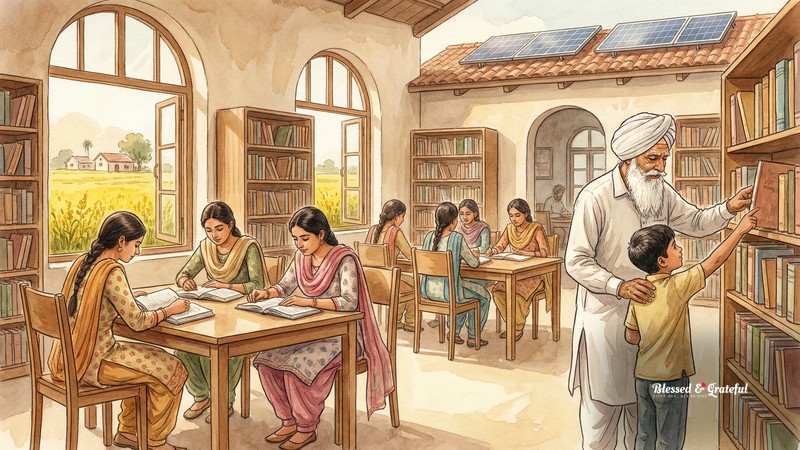
In the villages of Punjab, where golden mustard fields stretch to the horizon, something quiet and extraordinary is happening. Libraries are rising — not dusty, forgotten rooms with a few outdated textbooks, but bright, modern spaces with Wi-Fi, solar panels on the roof, and shelves lined with books on everything from poetry to quantum physics.
Two hundred and seventy-eight of them, so far. With fifty-eight more on the way. The Rural Library Scheme, launched by Chief Minister Bhagwant Singh Mann in August 2024, has transformed villages across the state. From Sangrur to Fazilka, from Ludhiana to the quiet border districts of Bathinda and Moga, communities that once had no place to sit and read now have air-conditioned reading rooms, digital resources, and collections that include competitive exam preparation alongside contemporary literature.
But the numbers only tell part of the story. What matters more is who's showing up. Jagdeep Singh, a student from Ladda village, comes every day. He says the environment is clean and the space is right for studying. And in border districts — Abohar, Fazilka, places that never had facilities like this — young women are walking through the doors of libraries for the first time, in large numbers, to study. That sentence deserves to sit with you for a moment. For the first time.
These libraries are open seven days a week, 8 AM to 9 PM, with some offering 24-hour study rooms. They run on solar power. They are free. And they are full. The vision behind them is simple enough: that a young person in a rural Punjabi village should have the same access to knowledge as anyone in a city. That the distance between a mustard field and a medical degree should be measured in curiosity, not geography.
In a world that sometimes feels like it's closing doors, Punjab is building rooms full of open ones.