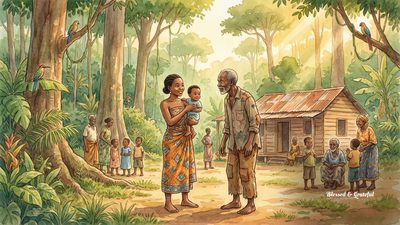
There is an island in the Gulf of Guinea, so far from the African mainland that evolution went its own way there. Giant land snails became apex predators. Trees grew into shapes found nowhere else on Earth. Scientists still discover new species in its canopy — just recently, an owl no one had ever documented before.
Príncipe is sometimes called the African Galápagos, and for good reason. But unlike the Galápagos, the people who live here — about 8,000 of them — have long struggled to make a living without cutting into the forest that makes the island extraordinary. After independence in 1975, the economy collapsed, and for decades survival meant taking what the land could give.
That tension between need and wonder is what makes this story so remarkable. The Faya Foundation, funded by South African tech billionaire Mark Shuttleworth, has launched what may be one of the most consequential conservation experiments on Earth: quarterly dividend payments directly to islanders who commit to an environmental protection code. Nearly 3,000 people — over 60 percent of Príncipe’s adult population — have signed up, and the first payment of roughly $890 has already been delivered.
“With this money we can have a proper floor in the house,” says Kamilson Lima, a 43-year-old agricultural worker. “And an inside toilet.” It is the kind of sentence that reminds you what conservation actually means when it reaches the people who live closest to the land. Shuttleworth himself put it simply: “The normal path to development for Príncipe would be to cut down forest and grow fair-trade peppercorns. But we want to reward them as stewards.”
The program also funds school improvements, financial literacy, and reorganization of the local cacao trade. Dividends are reduced if unauthorized tree-felling occurs — a community accountability model rather than a punitive one. As project CEO Jorge Alcobia says, “We have to explain that it’s not free money.” It isn’t. It’s recognition that the people who have lived alongside this forest for generations are the ones best positioned to protect it — and that they deserve to thrive while doing so.