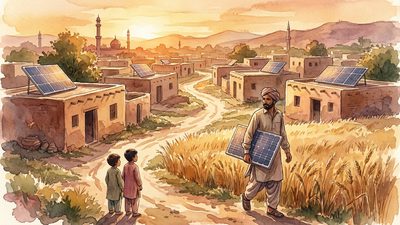
In some villages in lower Punjab, a farmer begins his day by carrying solar panels out to the field. During the long working hours, the panels power his irrigation pump. In the evening, he carries them home again — and they power his family's fans through the night. It is practical. It is also quietly extraordinary.
What has happened across Pakistan over the past few years is hard to summarize without making it sound like a policy story. It is not a policy story. It is a story about people. When electricity bills jumped by more than 150% in three years and the grid continued to cut out for hours at a time, Pakistani families began doing what people do when official solutions fall short: they found another way. Affordable solar panels had begun arriving from China, and a country that had almost no solar power a decade ago started putting panels on every surface it could find.
The movement built itself from the ground up, village by village. Young men learned installation from YouTube videos and WhatsApp groups, and became the electricians of their neighborhoods. In one community, a single solar array was mounted on a tractor and shared between three households — not because anyone told them to share it, but because that is what neighbors do. In the cities, solar panels began appearing in wedding dowries alongside televisions and refrigerators. Not as a luxury. As a necessity. As something a new family might actually need to live.
The people who benefited most, researchers found, were those who had historically received the least reliable service — rural communities in Sindh and southern Punjab, where the grid had always been more promise than reality. Nearly half of households in some of these regions have now adopted solar. For many families, it meant running a fan through a summer night for the first time. It meant a school that could keep its lights on. It meant a clinic that could reliably refrigerate medicine.
By the end of 2025, solar accounted for nearly a third of Pakistan's electricity — far more than any government target had projected, and achieved almost entirely without one. When a country transforms its energy system not through decree but through the accumulated choices of millions of ordinary families, each solving their own small piece of the same problem, something has happened that is worth pausing to notice. The sun was always there. They just decided, together, to use it.