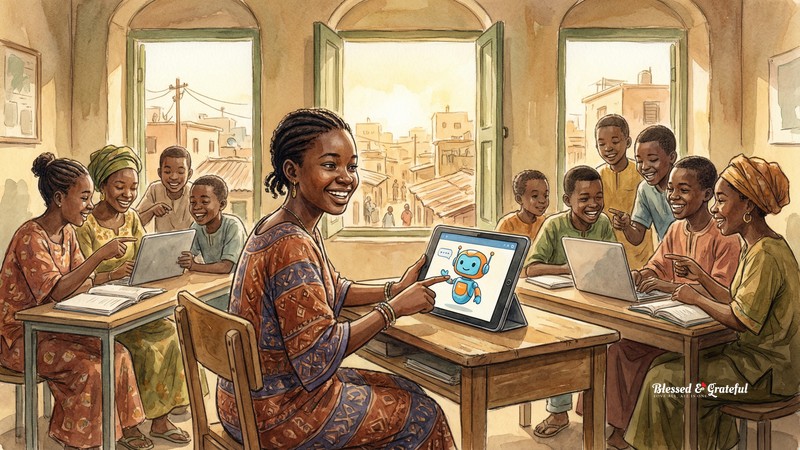
When Moustapha Diop started Jangalma in Dakar, he was simply trying to solve a problem he saw every day: families who wanted their children to succeed in school but couldn't afford a private tutor. What began as a modest home tutoring service has grown into something no one quite expected — an AI-powered learning platform that now reaches over 150,000 students across Francophone Africa, with an offline mode that works even when the internet doesn't.
The heart of the platform is Kocc, an AI tutor that can analyze a photo of a homework problem, answer voice questions in real time, and walk a student through a concept step by step — all in French, all aligned with official school curricula. Kocc doesn't replace teachers. It sits alongside them, filling the gap between what happens in an overcrowded classroom and what a student needs at ten o'clock at night when the textbook stops making sense.
What makes Jangalma remarkable isn't just the technology. It's the insistence that access matters more than novelty. The platform runs offline on basic smartphones — a deliberate choice for a region where connectivity is unreliable and expensive. More than 400 teachers contribute content, carefully vetted and mapped to the programs students actually follow. The result carries a 4.6 out of 5 rating from the families who use it.
The world has taken notice. Jangalma was selected among the 20 best educational startups globally at the World Summit on the Information Society, a joint initiative by the UN and UNESCO. And just this week, Diop was named one of 16 innovators shortlisted for the Royal Academy of Engineering's 2026 Africa Prize — the continent's largest prize for engineering innovation, recognizing solutions that create jobs and improve lives.
"We must train creators and builders, not just passive consumers," Diop has said. In living rooms and community centers across Senegal, Mauritania, and beyond, that's exactly what's happening — one homework problem at a time.