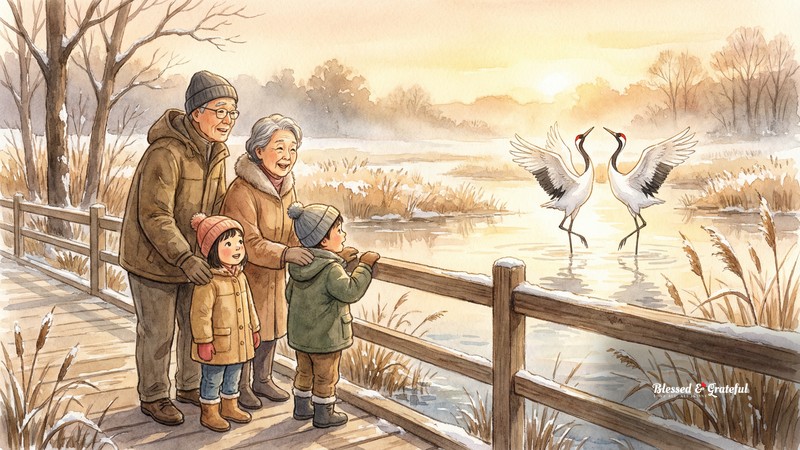
In 1952, wildlife surveyors counted thirty-three red-crowned cranes left in Japan. Thirty-three birds. A species that had been hunted nearly to silence during the Meiji era, then rediscovered, barely, in a remote Hokkaido wetland in 1924. The tanchō — as they are known in Japanese — had become so rare that most people assumed they were already gone.
The people of Tsurui village, deep in the Kushiro wetland, decided otherwise. Farmers began leaving grain out in winter. Conservation volunteers counted nests and monitored pairs through the frozen months. The Japanese government designated the crane a Special Natural Monument. Generation by generation, quietly and without great ceremony, a community committed itself to the long work of bringing something back.
This past March, Japan's Ministry of the Environment announced that the red-crowned crane has been downgraded from "threatened" to "near-threatened" — meaning the risk of extinction is now considered low. The current population stands at nearly 1,927 birds, a nearly sixty-fold increase over seventy years. It is one of the most remarkable wildlife recoveries in modern Japanese history.
The tanchō holds a particular place in Japanese culture. The proverb says cranes live for a thousand years; they appear on family crests, on wedding kimono, on the paper folds children learn to make when someone they love is ill. There is a quality to the crane that the Japanese have always recognized — something about the way it carries itself, the precision of its movements, the depth of its stillness — that feels like an invitation to pay attention.
The recovery wasn't without complexity. As the population expanded, cranes began moving into agricultural areas, eating crops. Some farmers who had spent decades protecting the birds now found them damaging their fields. The conservation work that comes next is the harder kind — negotiating coexistence, not just survival. But that, too, is part of the story: what it looks like when something genuinely comes back, when the relationship becomes real enough to have friction.
Seventy years of winter grain, left in the snow. Thirty-three birds, now nearly two thousand. The cranes of Hokkaido are home.