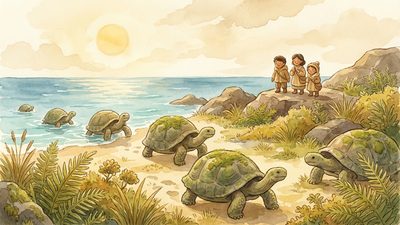
On a warm February morning in the Galápagos, something happened that had not happened in 180 years. Giant tortoises — slow, ancient, unhurried — stepped onto the volcanic soil of Floreana Island. One hundred and fifty-eight of them, each between twelve and fourteen years old, each carrying in their blood the memory of a lineage the world nearly lost.
The Floreana giant tortoise vanished from the island in the mid-1800s. Whalers took them. Fire ravaged the land. Humans came and went, and the tortoises simply disappeared — driven to what everyone believed was extinction. For generations, their absence was just a fact of the place. A silence where there had once been slow, steady life.
Then, in 2000, a researcher named James Gibbs noticed something unusual on Wolf Volcano, hundreds of miles away on Isabela Island. Some of the tortoises there had saddleback shells — a shape that didn't belong to that species. Genetic testing confirmed the impossible: these animals carried Floreana ancestry. Whalers, it turned out, had moved some tortoises between islands centuries earlier, and the lineage had quietly survived, hiding in plain sight among a different population.
What followed was decades of careful, patient work. A breeding program. Genetic screening. Raising juveniles to a size where they could survive on their own. And finally, on February 20th, 2026, the doors opened and the tortoises walked out — not into a zoo, not into a lab, but home. The 160 residents of Floreana were there to watch, many of them having participated in years of restoration planning. As one community member put it: their return shows what is possible when a community leads and many partners come together.
The tortoises are now wearing lightweight GPS transmitters, tracked hourly, watched over with the kind of care you give to something you almost lost forever. They are the first of twelve species planned for reintroduction on Floreana — ecosystem engineers whose slow grazing, seed-dispersing, earth-pressing presence will gradually reshape the island back toward what it once was. Some restorations happen with a bang. This one moves at the pace of a tortoise. Which is, perhaps, exactly the right speed.