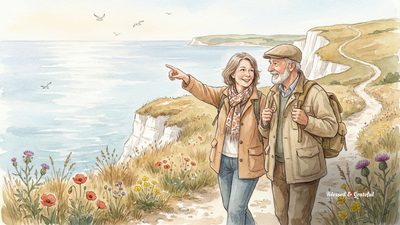
The day was March 19, 2026, and a quiet ceremony happened at Seven Sisters in Sussex — the kind of ceremony that doesn’t feel like it changes much, until you realise it actually changes everything. King Charles III walked two kilometres along the chalk clifftops above the English Channel and inaugurated a path that has been sixteen years in the making. The King Charles III England Coast Path now connects the entire English coastline — 2,700 miles, corner to corner, from Berwick-upon-Tweed in the north to the tip of Land’s End in the west. All of it, for everyone, forever.
But what made this moment feel like more than ribbon-cutting is what those miles represent. Before this path existed, walking England’s coast meant constant interruption — detours inland to avoid private land, stretches where walkers were forced onto roads, sections where the sea was simply off-limits. Over a thousand of the path’s 2,700 miles are entirely new — negotiated, cleared, built, and mapped over sixteen years through the collaboration of fifty coastal authorities, landowners, Wildlife Trusts, the National Trust, and walking organisations including the Ramblers and the Disabled Ramblers. The sea was always there. Getting to it was the work.
There is something in a small legal provision built into the path — called a “rolling easement” — that feels quietly profound. As England’s coast erodes and shifts, the path will move with it. Access to the shore is written not just into maps but into the future. It is, in a sense, a promise: that whatever the coastline becomes, people will still be able to walk it.
Tony Juniper, Chair of Natural England, said at the inauguration: “This is a path that reconnects people with the land.” For a country where only a small fraction of the countryside is legally open to the public, the coast has long been somewhere people felt they should have access to — and now, at last, they do. There are white cliffs and fishing villages, seabirds and salt marshes, beaches that look like they belong to the edge of the world. Most people will never walk all 2,700 miles. But the knowledge that you could — that any morning you can walk out the door and follow the shoreline as far as you want, and it will receive you — is its own kind of gift.