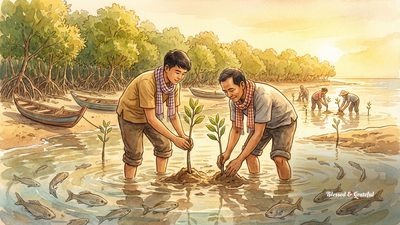
There is a village on the coast of Cambodia, near the Gulf of Thailand, where a father and son walk into the shallows each morning. Not to fish — though they do that too — but to plant trees. Mangrove saplings, thin as a child’s wrist, pushed gently into the mud where the tide reaches. Khiev Sat, the village chief of Koh Kresna, has been doing this for years now. His son Khiev Chien, just twenty-one, works beside him.
It wasn’t always like this. After the Khmer Rouge fell in 1979, Cambodia was shattered. “People had nothing,” Khiev Sat remembers. Desperate families cut the mangroves for charcoal — the trees that had sheltered their coastline for generations. Without those tangled roots beneath the waterline, the nursery vanished. Baby fish had nowhere to grow. The catch dwindled to almost nothing. Some families left for the factories. Others left Cambodia altogether.
Then, in 2003, Koh Kresna and the neighboring village of Lok did something quiet and radical. They formed a community fishery — not waiting for anyone to save them, but choosing to save themselves. They drew a line around 145 acres of coastline and said: these mangroves, we protect. Over the last two years alone, they have planted more than 2,000 new saplings, with support from the Red Cross and Landesa.
And the fish came home. Mackerel, sardines, bream, squid, anchovies, crabs, pink shrimp — the Gulf of Thailand off Koh Kresna now teems with life again. Scientists say mangrove roots support 800 billion young fish and crustaceans every year worldwide, and store four times more carbon than other forests. Khiev Chien understands what they are part of. “We are helping the whole world,” he says, simply.
“Our community fishery is strong,” his father adds. And then he says the thing that matters most: “I want to give the people a better life.” He is standing in the water when he says it. Around him, the saplings sway. Beneath the surface, something is growing.