🫔 Tamales — The Recipe That Requires a Village
Mexico and Central America — from Oaxaca to Guatemala to every kitchen where someone says 'it's time to make tamales' and the whole family shows up
The Story
Nobody makes tamales alone.
You can. Technically. The way you can technically build a house by yourself or raise a child alone or carry a couch up three flights of stairs without help. You can do it. But the tamale resists individual effort. It is engineered for a group.
The process is long. Not hard — none of the individual steps are hard — but long. You soak the corn husks. You make the masa — corn dough, lard, broth, salt — and beat it until it's light enough that a spoonful floats in water. You prepare the filling: pork in red chile, chicken in green salsa, cheese with rajas (roasted pepper strips), sweet tamales with pineapple or strawberry. You spread the masa on the husk, spoon in the filling, fold, tie, and stack them in the pot. Then you steam them for an hour or more.
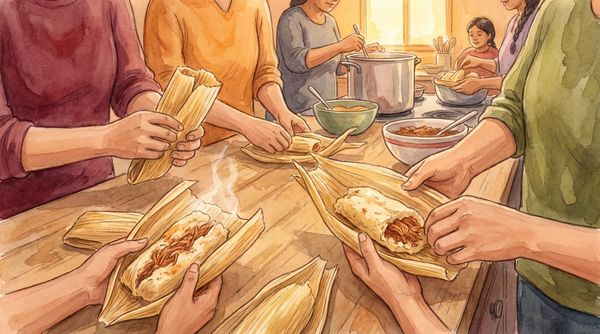
One person soaking husks. One person spreading masa. One person filling. One person folding. One person watching the pot. The assembly line forms naturally because that's how tamales have been made for at least 8,000 years. The Aztecs made them. The Maya made them. The Olmec probably made them. This is one of the oldest prepared foods in the Americas, and the process has always been communal.
The Cultural Moment
Tamales are pre-Columbian. They are older than the Aztec empire, older than the Maya cities, older than most of what we think of as "civilization" in the Americas. Archaeological evidence suggests some form of tamale has existed in Mesoamerica since at least 8000 BCE. They were portable, durable, and could be filled with whatever was available — meat, beans, fruit, chiles, nothing at all. Warriors carried them. Travelers carried them. Women made them by the hundreds for festivals and ceremonies.
The tamalada — the tamale-making gathering — is the beating heart of the tradition. In Mexican and Central American families, the tamalada happens before Christmas, before Día de los Muertos, before weddings, before any event large enough to require more food than one person can make. The entire extended family gathers. The kitchen becomes a factory. Children learn by watching and then by doing — first the easy jobs (soaking husks, passing spoons), then the skilled ones (spreading masa evenly, folding the perfect seal).
In diaspora communities, the tamalada is also an act of cultural preservation. When you make tamales with your grandmother in Houston or Chicago or Los Angeles, you're not just making food. You're maintaining a thread that connects you to a kitchen in Puebla or Oaxaca or Guatemala City that connects to a kitchen before that, and before that, back further than anyone can trace.
The Recipe
This is a starting point — pork tamales in red chile sauce. Tamale recipes vary enormously by region and family. This one is designed to be approachable. Make them with people if you can.
Makes: about 24 tamales (this is already a scaled-down batch)
You'll need:
- 1 package dried corn husks (about 30 — some will tear, extras are good)
- 2 lbs pork shoulder, cut into large chunks
- 4 dried guajillo chiles (mild, sweet)
- 2 dried ancho chiles (deep, fruity)
- 3 cloves garlic
- 1 teaspoon cumin
- Salt to taste
- 3 cups masa harina (corn flour for tamales, like Maseca)
- 1 cup lard or vegetable shortening (lard is traditional and gives the best texture)
- 2 cups warm pork broth (from cooking the pork)
- 1 teaspoon baking powder
- 1 teaspoon salt
Soak the corn husks in hot water for at least an hour — weigh them down with a plate so they stay submerged.
Boil the pork in salted water until tender — about 2 hours. Shred it. Save the broth.
Toast the dried chiles in a dry pan for 1–2 minutes until fragrant. Remove stems and seeds. Soak in hot water for 20 minutes. Blend with garlic, cumin, salt, and a little soaking water into a smooth sauce. Simmer the sauce for 10 minutes, then mix with the shredded pork.
For the masa: Beat the lard with a mixer until fluffy — 3 to 5 minutes. Add the masa harina, baking powder, and salt. Slowly add the warm broth, mixing until you have a soft, spreadable dough. Test it: drop a small ball into a cup of water. If it floats, it's ready. If it sinks, keep beating.
Assemble: Take a soaked husk, spread about 2 tablespoons of masa in a thin rectangle on the wide end. Spoon a line of filling down the center. Fold the sides of the husk over the masa, then fold the narrow bottom up. Place upright in a steamer pot, open end up, packed snugly so they support each other.
Steam for 1 hour to 1 hour 15 minutes. The tamales are done when the masa pulls cleanly away from the husk.
Let them rest 10 minutes before serving. The resting is when they set. Be patient. You've already waited this long.
The Gathering Note
The tamalada is not about the tamales. The tamales are the excuse.
The tamalada is about your aunt telling the same story she told last year. It's about your cousin's kid learning to fold a husk and getting masa everywhere. It's about the radio playing in the background and nobody agreeing on the station. It's about the rhythm — spread, fill, fold, stack — that lets your hands move while your mouth talks and your heart settles into the specific peace of doing a thing together that none of you could do as well alone.
When you need your hands busy, make tamales. But don't make them alone. Call someone. Anyone. The tamales will wait until the people arrive.