🍝 Sunday Gravy — The Sauce That Takes All Day
Italian-American — from the tenements of Little Italy to every kitchen where someone's nonna is watching over the stove
The Story
It's not sauce. It's gravy. And if you call it sauce in the wrong kitchen, someone will correct you with a look that has been passed down through four generations.
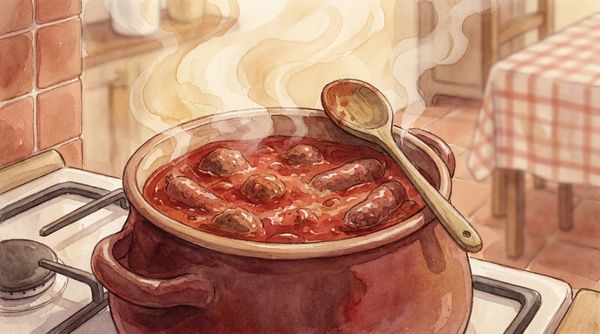
Sunday gravy is not a recipe. It's a day. It starts in the morning — early, before anyone else is up, when the kitchen is quiet and the only sound is the click of the gas burner and the first sizzle of garlic in olive oil. The tomatoes go in. The meat goes in. And then you wait. You wait for hours. You stir. You taste. You add a little more salt. You taste again. The house fills with a smell that doesn't peak — it just deepens, layer after layer, until the walls are holding it.
The meat is the architecture. Not one kind — many. Pork ribs, sweet Italian sausage, braciole (thin beef rolled around a filling of breadcrumbs, garlic, parsley, and Pecorino cheese, tied with kitchen twine), maybe meatballs if the family does meatballs in the gravy (some do, some don't — another generational fault line). Each piece of meat gives something different to the sauce. The sausage gives fat and fennel. The ribs give body. The braciole gives that slow-cooked beef depth. By the time the gravy is done, the meat is so tender it falls apart when you look at it, and the sauce has absorbed every story those bones had to tell.
The Cultural Moment
Sunday gravy is an Italian-American invention. In Italy, the closest equivalent is ragù Napoletano — a slow-cooked meat sauce from Naples. But Sunday gravy as it exists in New Jersey, Philadelphia, Brooklyn, Boston, and Chicago is its own thing. It's what happened when Southern Italian immigrants brought their food traditions to America and adapted them to what was available and affordable in a new country.
In Italy, the meal was the midday pranzo della domenica — Sunday lunch, the longest and most important meal of the week. In America, it shifted to Sunday afternoon or early evening, because work schedules changed but the principle didn't: one day a week, the family sits down together and nobody leaves the table until the table decides they can.
The sauce/gravy debate is a regional and generational marker. "Gravy" is more common in Italian-American communities in the Northeast — New York, New Jersey, Philadelphia. "Sauce" is used more broadly. Both are correct. Neither side will ever yield. It is the Jollof Wars of Italian America.
The Recipe
This takes all day. That's not a warning — that's the invitation. Start in the morning. Stir when you remember. Taste when you can't help it. The sauce is done when the house smells like your grandmother's house.
Serves: 8–12 (this is meant for a crowd — and for leftovers)
- 2 cans (28 oz each) San Marzano whole peeled tomatoes (crush them by hand into the pot)
- 1 can (6 oz) tomato paste
- 1 lb sweet Italian sausage links
- 1 lb pork spare ribs or country-style ribs, cut into individual ribs
- 1 lb braciole (ask your butcher for thinly pounded beef top round)
- 1 large onion, finely diced
- 6 cloves garlic, sliced thin
- 1/2 cup good olive oil
- 1 cup dry red wine (drink the rest while you cook)
- Fresh basil — a big bunch, torn
- 1 teaspoon dried oregano
- 1 teaspoon sugar (cuts the acidity of the tomatoes)
- Salt and black pepper to taste
- Pecorino Romano for grating at the table
Brown the meats in olive oil in a large, heavy pot — in batches, don't crowd them. Sausage, ribs, braciole. Get a good sear on all sides. Remove and set aside. In the same pot, cook the onion until soft. Add the garlic — only a minute, don't let it burn. Add the tomato paste and stir it into the oil for 2 minutes. Pour in the wine and scrape the bottom of the pot — all that brown fond is flavor.
Add the crushed tomatoes, sugar, oregano, half the basil, salt, and pepper. Return all the meat to the pot. Bring to a gentle bubble, then reduce to the lowest possible simmer. Cover — but leave the lid slightly cracked.
Simmer for 4 to 6 hours. Stir every 30 minutes or so. The sauce will go from bright red to a deep, almost burgundy color. The meat will become impossibly tender. Taste. Adjust salt. Add the remaining fresh basil in the last 30 minutes.
Cook your pasta — rigatoni, penne, or whatever the family demands. Toss with sauce. Serve the meat on a separate platter. Grate Pecorino over everything. Argue about whether it needs more cheese. It always needs more cheese.
The Gathering Note
The meal lasts longer than the cooking — and the cooking takes all day. That's the design.
Sunday gravy is not efficient. It cannot be meal-prepped or batch-cooked in any way that preserves what it actually is. Because what it actually is isn't the sauce. It's the day. It's the morning quiet, the slow stir, the kitchen that fills up as the hours pass, the people who drift in and out, the argument about the cheese, the second helping no one needed but everyone takes.
When the house is full of people, the gravy is what holds them there. Not because they can't leave. Because they don't want to.