🍗 Southern Chicken and Dumplings — The Casserole Dish with Your Name on the Bottom
The American South — and every porch, church hall, and kitchen where someone showed up with a pot
The Story
Somebody died.
That's usually how it starts. Or somebody got sick. Or somebody had a baby. Or somebody's husband left. Or the tornado took the carport. The details change; the response doesn't. Within hours, women start arriving at the door carrying pots, and the first pot — the one that arrives before anyone has figured out what to say — is almost always chicken and dumplings.
In the American South, this dish is not cooked from a recipe. It is cooked from obligation — the good kind, the kind that doesn't ask permission. You hear the news. You go to the kitchen. You pull out a whole chicken because a whole chicken is what you have and it is what the situation requires. Nobody calls ahead. Nobody asks what the family wants. That's not how it works. How it works is: you show up with the pot, you put it on the counter, you say "I brought you something," and you leave. Or you stay, if staying is what they need. The food decides nothing. The food just makes sure nobody has to think about dinner tonight.
The casserole dish has your name taped to the bottom. Masking tape, in pen. This is a universal Southern system. Everyone tapes their name because everyone knows the dish is coming back empty and nobody can remember whose Pyrex is whose after the third funeral this year. The tape is practical. It is also a signature. I was here. I brought this. You are not alone in this.
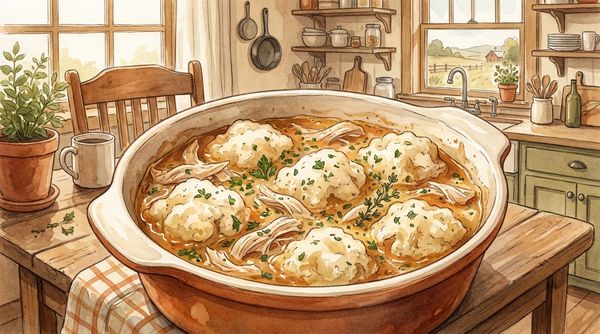
Chicken and dumplings is not a beautiful dish. It is not plated. It does not photograph well. It is a pot of cloudy golden broth with shredded chicken and thick, pillowy dumplings that have swollen to fill every gap, the way the dish itself fills the gap that grief opens up in a household. The broth is rich because it was made from a whole bird simmered for hours. The dumplings are soft because they were dropped into that broth raw and allowed to steam until they became something between bread and cloud. There is nothing crunchy. There is nothing sharp. Every texture in this pot is gentle.
That's on purpose.
When someone is hurting, you don't bring food that demands attention. You bring food that asks nothing. You bring food that reheats. You bring food that a person can eat standing in the kitchen at 2 AM when they couldn't sleep and didn't know they were hungry until they opened the pot and the steam hit their face and something in their chest loosened, just slightly, just enough.
That's what chicken and dumplings does. It loosens things. Just slightly. Just enough.
The Cultural Moment
The tradition of bringing food to a house in crisis is not uniquely Southern, but the South turned it into an infrastructure. In small towns across Alabama, Mississippi, Georgia, Tennessee, the Carolinas — the phone tree still works. Someone calls someone who calls someone, and within a day the kitchen counter is covered. Chicken and dumplings. Green bean casserole. A ham. Banana pudding. Sweet tea in a gallon jug. Rolls wrapped in foil.
The hierarchy is unspoken but real. Chicken and dumplings is the first responder. It is the dish that says I heard, and I'm here. The ham comes later — that's for the gathering after the funeral, when the house is full. The banana pudding is dessert, which means someone thought far enough ahead to believe the family would still want sweetness. Each dish is a sentence in a language the South has been speaking for generations.
In Black Southern kitchens, chicken and dumplings carries additional weight. The dish descends from enslaved cooks who stretched a single chicken into enough food for a family through ingenuity — the broth extended with flour, the dumplings making fullness from almost nothing. What was born from scarcity became, over generations, something sacred. The pot of chicken and dumplings that arrives at a Black church homecoming or a repast after a funeral is not just comfort food. It is an inheritance.
Every Southern cook makes dumplings differently, and every Southern cook believes their way is the only way. Rolled dumplings — flat, slick, cut into strips — are the old way, the Appalachian way, the way that makes the broth thick and almost gravy-like. Drop dumplings — spooned in as soft balls of batter — are fluffier, lighter, the kind that puff up in the broth like small clouds. The argument between these two styles has ended zero marriages but has certainly tested some.
Both are correct. Your grandmother's version is the most correct.
The Recipe
This is drop dumplings — the fluffy kind — because when someone is hurting, softness is the point. If your family does rolled dumplings, do those instead. The chicken doesn't care about the argument.
Serves: 8-10 (this pot is not for one household — it's for whoever walks through the door)
For the chicken and broth: - 1 whole chicken (about 4 lbs) — not pieces, the whole bird - 1 large onion, quartered - 3 stalks celery, broken in half - 3 carrots, broken in half - 4 cloves garlic, smashed - 2 bay leaves - 1 tablespoon whole black peppercorns - Salt — more than you think - Enough cold water to cover everything by 2 inches
For the dumplings: - 2 cups all-purpose flour - 1 tablespoon baking powder - 1 teaspoon salt - 3/4 cup whole milk (or buttermilk, if you have it — the dumplings will be tangier and more tender) - 2 tablespoons butter, melted
What you do:
Put the whole chicken in your biggest pot. Add the onion, celery, carrots, garlic, bay leaves, and peppercorns. Cover with cold water. Bring it to a boil, then drop the heat to the gentlest simmer you can manage — the surface should barely move. A rolling boil makes tough chicken. A gentle simmer makes chicken that falls apart when you look at it.
Simmer for 90 minutes to 2 hours. Don't rush this. The house will start to smell like someone is taking care of things. That's the broth working.
Pull the chicken out and set it on a cutting board. Strain the broth through a fine-mesh strainer into a clean pot — you want that broth golden and clear, nothing cloudy. Discard the vegetables. They've given everything they had.
When the chicken is cool enough to handle, pull the meat off the bones. Shred it with your hands — forks work but hands are better because you can feel the grain and pull with it. Discard the skin and bones. You'll have a generous pile of shredded chicken. Set it aside.
Bring the strained broth back to a gentle boil. Taste it. Add salt until it tastes like the thing you needed. This is the foundation — if the broth isn't right, nothing else matters.
Make the dumplings. Mix the flour, baking powder, and salt. Add the milk and melted butter. Stir until just combined — lumpy is fine, overworked is not. The batter should be thick and sticky, like very wet biscuit dough.
Drop spoonfuls of batter into the simmering broth. Use a soup spoon — each dumpling should be about the size of a golf ball. They'll look too small. They will double in size. Don't crowd them — work in batches if you need to.
Once all the dumplings are in, cover the pot. Do not lift the lid for 15 minutes. The dumplings are steaming, and they need the trapped steam to puff up properly. If you lift the lid, they'll be dense. Trust the pot.
After 15 minutes, lift the lid. The dumplings will have swollen, the broth will have thickened slightly from the flour, and the whole pot will look like a hug in liquid form.
Add the shredded chicken back in. Stir gently — the dumplings are tender. Season one final time.
Ladle into bowls. No garnish needed. This is not that kind of dish.
The Gathering Note
When you bring this to someone's house, bring it in a pot with your name taped to the bottom. Don't bring a ladle — they have one. Don't bring bowls — they have those too. Don't ask if they need anything else. Just put the pot on the counter and say, "There's chicken and dumplings on the stove whenever you're ready."
They might not be ready tonight. They'll be ready at 2 AM. The pot will still be there. The broth will still be warm enough. And for a few minutes, standing in a dark kitchen eating something someone made because they heard the news and went straight to the stove, the world will feel slightly less broken.
That's all this dish has ever promised. It's enough.