🌿 Sabzi Polo Mahi — The Meal That Waits for the Exact Second
🇮🇷🇦🇫🇹🇯 Iran, Afghanistan & the Persian world — the dish that marks the moment winter ends
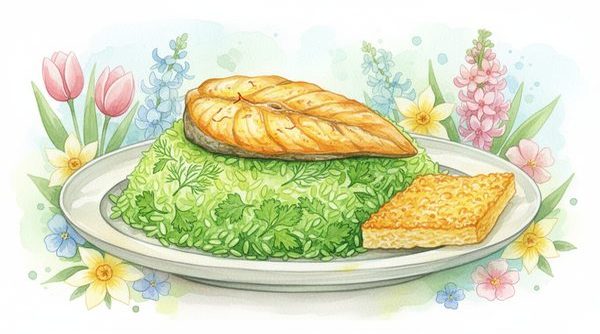
The Story
The new year does not begin at midnight.
Not in a Persian household. Not in the Iranian diaspora kitchens of Los Angeles or Toronto or London. Not for the Afghans who celebrate it, or the Tajiks, or the Azerbaijanis, or the Kurdish families in northern Iraq who have kept this holiday alive for three thousand years. The year begins at the exact second the sun crosses the equator — the vernal equinox — and that second falls wherever it falls: 6:47 in the morning, 11:24 at night, 2:17 in the afternoon on a Tuesday. The family is already at the table when it arrives. The sabzi polo mahi is already made.
The preparation began the day before, or the week before. The herbs were dried or bought fresh and cleaned and chopped: dill and fenugreek and parsley and chives, in proportions that vary by household and by grandmother and by what was available at the market. The rice was washed until the water ran clear, soaked in salted water, then cooked in the Persian way — with a crust forming at the bottom called the tahdig, the part everyone wants, the part that makes the cook proud. The fish was prepared. The table was set with the haft-sin — seven items whose names begin with the Persian letter "sin", each one symbolic: sprouts for renewal, vinegar for patience, garlic for health, coins for prosperity.
And then the countdown begins. Not to midnight. To a specific second that astronomers have calculated to the minute. When it arrives, the family is together. The new year begins in the precise instant that the earth does the thing it always does, and human beings stop to notice.
The herbs in the rice turn it green. The fish on the side gleams. Outside, it is the first day of spring.
The Cultural Moment
Nowruz — now (new) rūz (day) in Persian — is one of the oldest holidays on earth, with roots in Zoroastrian tradition that predate Islam by a thousand years. It has been celebrated for at least three millennia across what is now Iran, Afghanistan, Tajikistan, Azerbaijan, Kazakhstan, Uzbekistan, and among Kurdish communities throughout the Middle East. The UN recognized it as an international day of celebration in 2010. UNESCO named it Intangible Cultural Heritage in 2009.
Sabzi polo mahi is the specific meal of Nowruz eve and the new year table. The green of the herb rice (sabzi = herbs, polo = rice) represents spring, renewal, and the color returning to the world after winter. The fish (mahi) represents life, progress, and forward movement — fish always swim forward, always face the current. Together, the dish enacts the holiday's deepest meaning: the world is turning again, life is moving again, spring has arrived, and we are at the table together to mark it.
The tahdig — the golden crust of rice that forms at the bottom of the pot — is not unique to Nowruz, but it matters especially here. It is the honored piece, the part guests are served first, the measure of the cook's skill and patience. A good tahdig is something people talk about. A burned tahdig is a family story for decades. The crust is the consequence of paying attention. So is the holiday.
The Recipe
This is a home version of mansaf — scaled for a family rather than a tribe, but keeping the soul intact. The jameed is the ingredient that cannot be substituted. Find it at Middle Eastern grocery stores, usually vacuum-sealed or as a dried block. Without jameed, you are making lamb and rice. With jameed, you are making mansaf.
Serves: 8–10 (mansaf does not scale down gracefully)
For the lamb:
- 4–5 lbs bone-in lamb (shoulder or leg pieces, cut large)
- 1 large onion, quartered
- 3 cardamom pods, cracked
- 2 bay leaves
- 1 cinnamon stick
- 1 teaspoon whole black peppercorns
- Salt
- Water to cover
For the jameed sauce:
- 2 lbs jameed (fermented dried yogurt — the block form, found at Middle Eastern grocers)
- 3–4 cups of the lamb cooking broth
- 1 cup plain full-fat yogurt (to stabilize and add body)
- Salt to taste
For the rice:
- 3 cups long-grain basmati rice
- 2 tablespoons ghee or butter
- 1 teaspoon turmeric
- 1 teaspoon ground cumin
- 1 teaspoon ground cinnamon
- Salt
- The lamb cooking broth (as needed, about 5 cups)
For the platter:
- 2–3 large rounds of markook or shrak flatbread (thin, paper-like Arabic flatbread — or use large flour tortillas as a substitute)
- 1/2 cup slivered almonds, toasted in butter until golden
- 1/4 cup pine nuts, toasted in butter
- Fresh flat-leaf parsley, chopped
The day before (or morning of): Break the jameed into pieces and soak in cold water overnight, or for at least 4 hours. It will soften and begin to dissolve. Work it with your hands to break it down, then blend until smooth. It will look pale and thin. This is correct.
Cook the lamb: Place the lamb in a large pot with the onion, cardamom, bay leaves, cinnamon, peppercorns, and enough cold water to cover by two inches. Bring to a boil, skim the foam, then reduce to a gentle simmer. Cook for 1.5 to 2 hours until the lamb is completely tender and beginning to fall from the bone. Remove the lamb and set aside. Strain and reserve the broth. You need this broth for both the rice and the jameed sauce.
Make the jameed sauce: In a heavy saucepan, combine the blended jameed with 3–4 cups of warm lamb broth. Stir over medium heat, always stirring in one direction, until the sauce comes to a gentle simmer. Do not let it boil hard — it can break. Add the cup of plain yogurt. Continue stirring. The sauce should be the consistency of a thin gravy, pale and ivory-colored, with a sharp, tangy, deeply savory smell. Season with salt. Add the cooked lamb to the sauce and let it simmer together gently for 20–30 minutes. The lamb will absorb the jameed flavor and the sauce will deepen.
Cook the rice: In a large pot, melt the ghee over medium heat. Add the turmeric, cumin, and cinnamon and stir for 30 seconds. Add the washed and drained rice and stir to coat. Add 5 cups of the warm lamb broth (or water if you've used the broth for the sauce). Season with salt. Bring to a boil, then reduce to the lowest possible heat, cover tightly, and cook for 18–20 minutes until the rice is tender and the liquid absorbed.
Assemble the platter: Lay the flatbread across the platter, overlapping, covering the entire surface and draping over the edges. Mound the rice in the center and spread across the bread. Arrange the lamb pieces on top of the rice. Ladle the jameed sauce generously over everything — over the lamb, over the rice, over all of it. The bread at the bottom will absorb the overflow. Scatter the toasted almonds and pine nuts across the top. Finish with the fresh parsley.
Bring the remaining jameed sauce to the table in a pitcher or pot. Pour more as you eat.
Stand around the platter. Eat with your right hand.
"You'll know it's ready when the jameed sauce smells like the desert and the lamb answers to your touch."
The Gathering Note
There is a Jordanian tradition at mansaf: the host keeps adding food to the platter as people eat. Pours more jameed. Brings more rice. The platter does not empty as long as the host has anything left to give. The guest is not supposed to finish everything. To empty the platter completely would suggest that the host did not provide enough, and that is the one thing that cannot happen. The abundance is not accidental. The abundance is the point.
When someone is about to leave, this abundance takes on weight. Every ladle of jameed poured at the table is the host saying: take this with you. Take the memory of this sauce, this lamb, this platter, these hands reaching in beside yours. Take the knowledge that wherever you're going, this table exists and it belongs to you.
The standing means you are ready. Not ready in the sense of wanting to go. Ready in the sense of being present for what is happening. The departure is real. The love is real. Both of these things are true at the same time, and mansaf holds both of them in the same platter.
Eat until it is time to go. Then go. You will carry this meal further than you think.