🍜 Ramyeon — The 3 A.M. Bowl
South Korea — from convenience stores to dorm rooms to every Korean kitchen where someone needs comfort in under ten minutes
The Story
It's instant noodles. Let's get that out of the way first.
Ramyeon (라면) is instant noodles. It comes in a packet. It has a foil seasoning pouch and sometimes a second pouch of dried vegetables and sometimes a third pouch of oil or chili flakes. You boil water, you cook the noodles, you add the seasoning, and four minutes later you're eating. This is not a secret. This is not elevated. This is not "chef's ramen." This is the packet from the store.
And it is one of the most beloved, most eaten, most emotionally significant foods in South Korea.
Koreans eat approximately 80 packets of ramyeon per person per year — among the very highest per-capita instant noodle consumption in the world; only Vietnam eats more. Not because they can't cook. Because ramyeon is more than cooking. It's a ritual. It's a late-night comfort. It's what you eat when you're studying at 2 AM or when you've come home from drinking or when you're alone and the world is too much and you need something hot and spicy and ready in four minutes.
The Cultural Moment
Ramyeon arrived in South Korea in 1963 when Samyang Food produced the country's first instant noodle — modeled on Japanese technology but seasoned for Korean palates. Within a generation, it became a national staple. Today, Korea's ramyeon industry produces billions of packets a year, and brands like Shin Ramyeon, Jin Ramen, and Samyang Buldak are exported worldwide.
The significance of ramyeon in Korean culture goes far beyond convenience. The phrase "Do you want to eat ramyeon?" ("Ramyeon meokgo gallae?") has become a cultural double entendre — famously, an invitation to come upstairs, a euphemism for romantic interest. It's been a plot device in K-dramas, a meme, and a genuine social code. Because ramyeon is intimate. You eat it late at night. You eat it in your pajamas. You eat it when your guard is down.
In Korean convenience stores, there are hot water dispensers and eating counters specifically for ramyeon. You buy the packet, open it, add the hot water, and eat it right there, standing at the counter by the window. It's a communal solitary act — alone together, everyone eating their own bowl, nobody talking, everybody satisfied.
The Recipe
This is the proper way to make a single serving of Korean ramyeon. Not the way the packet says. The way that makes it right.
Serves: 1 (this is a solo ritual)
- 1 packet of Korean ramyeon (Shin Ramyeon is the classic, but use whatever your store has)
- 2 cups water (500ml — slightly less than the packet suggests, for a thicker broth)
- 1 egg
- 1 scallion, sliced
- 1 slice of Korean processed cheese (optional — but the way it melts into the broth is a revelation)
- Kimchi — a handful, preferably a little aged
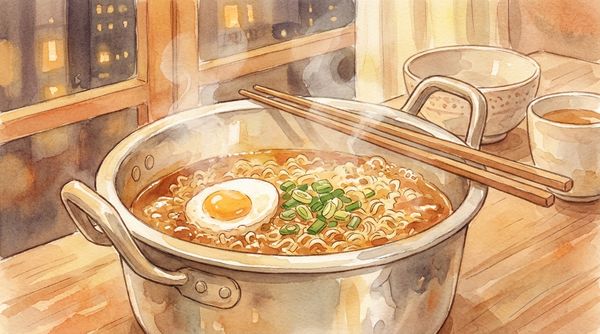
Boil the water in a small pot — a Korean yangpan (the small aluminum pot with a lid) if you have one. Add the soup base and dried vegetable packet first, before the noodles. Let it boil for 30 seconds so the seasonings dissolve.
Add the noodles. Cook for exactly 3 minutes — not 4 (the packet lies). At the 2-minute mark, crack the egg directly into the pot. Don't stir it — let the white set around the noodles while the yolk stays runny.
In the last 30 seconds, add the scallion and, if using, lay the cheese slice on top. Turn off the heat. Cover for 30 seconds.
Eat it from the pot if you're alone. That's not laziness — that's tradition. The aluminum pot keeps it hotter longer, and the act of eating from the pot is part of the ritual. Use chopsticks for the noodles and a spoon for the broth.
The kimchi goes on the side. You alternate — bite of noodle, bite of kimchi, sip of broth. The spice builds. The egg yolk breaks into the soup. The cheese melts into something that shouldn't work but absolutely does.
The Gathering Note
Ramyeon at 3 AM is not about hunger. It's about stillness.
The world is quiet. Everyone else is asleep. It's just you and the pot and the steam and the four minutes of waiting that feel like the only four minutes today that belonged entirely to you.
This is the meal that doesn't judge. It doesn't ask how your day was. It doesn't need you to be anything. It just needs you to be awake enough to boil water.
The broth is hot. The noodles are ready. The night is yours.