🫓 Pupusas — The Griddle, the Curtido, and the Line Around the Block
El Salvador — and every pupusería, street corner, and kitchen in the diaspora where corn dough meets filling and everyone gets in line
The Story
The line starts before the griddle is hot.
Outside a pupusería in San Salvador, or in Los Angeles, or in Houston, or in any neighbourhood where Salvadorans have settled and opened a kitchen, the line forms with the particular patience of people who know exactly what they're waiting for and have no intention of being anywhere else. The menu is simple. The wait is part of the experience. The pupusa is worth both.
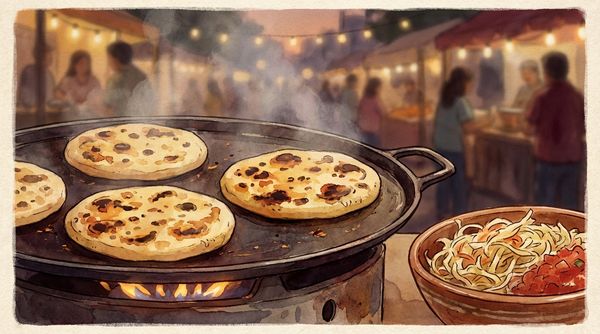
A pupusa is a thick corn tortilla stuffed with filling — cheese, beans, pork, or some combination of all three — cooked on a flat griddle (comal) until the outside is golden and slightly crisp and the inside is molten. It fits in your hand. It costs almost nothing. It is, by any reasonable measure, one of the most perfect foods ever invented.
The dough is masa — corn dough, made from dried corn that's been treated with lime in a process called nixtamalisation that's been practiced in Mesoamerica for thousands of years. The masa for pupusas is softer and wetter than tortilla masa, almost like a thick paste. You take a ball of it, press it flat in your palm, place a spoonful of filling in the centre, fold the dough over the filling, and pat it back into a disc. The filling disappears inside. The dough seals itself.
Then it goes on the griddle.
The sound is immediate — a soft sizzle as the wet dough meets the hot metal, then a quieter cooking sound as the pupusa firms up and begins to develop its crust. The cook flips it once, presses it gently with a spatula, and waits. The cheese inside begins to melt. The beans soften further. The pork — chicharrón, which in pupusa language means finely ground seasoned pork, not the crispy fried skin — releases its fat into the dough and makes everything richer.
When it comes off the griddle, the pupusa is placed on a plate next to two things that are as essential as the pupusa itself: curtido and salsa roja.
Curtido is a lightly fermented cabbage slaw — shredded cabbage, carrots, and onion, dressed in vinegar with a pinch of oregano. It's tangy and crunchy and bright, and its job is to cut through the richness of the pupusa the way a best friend's honesty cuts through your self-deception. Without curtido, a pupusa is still good. With curtido, it's complete.
Salsa roja is a thin, smooth tomato sauce — cooked tomatoes blended with garlic, chilli, and sometimes a bit of chicken broth. It's not hot (usually). It's savoury and warm and ties everything together. You pour it over the pupusa, or dip the pupusa into it, or — if you're eating at a pupusería where the salsa comes in a squeeze bottle — you draw lines across the top and pretend you're an artist.
The first bite is always the best. The crust gives way, the filling oozes, the curtido crunches, and for a moment your entire sensory world is a pupusa in El Salvador at noon on a Sunday, even if you're actually standing in a strip mall in Virginia.
The Cultural Moment
Pupusas are ancient. Archaeological evidence at the Joya de Cerén site in El Salvador — a Mayan village preserved by volcanic ash around 600 AD — includes tools and food preparation areas consistent with pupusa-making. The Pipil people, indigenous to western El Salvador, are credited with the dish's development, and the word pupusa likely comes from the Pipil language: pupusawa, meaning "swollen" or "stuffed."
For Salvadorans, the pupusa is not just food. It is national identity, literally codified: in 2005, the Salvadoran government declared the second Sunday of every November as Día Nacional de la Pupusa — National Pupusa Day. On that day, pupuserías across the country compete to make the largest pupusa, crowds gather in town squares, and the entire nation pauses to celebrate a corn cake. This is not kitsch. This is a country saying: this is who we are.
The pupusa also carries the weight of El Salvador's history. During the civil war of the 1980s, which killed over 75,000 people and displaced more than a million, Salvadorans fled to the United States, Mexico, Canada, Australia. They carried almost nothing. They carried the pupusa.
In Los Angeles, the Salvadoran population grew rapidly during and after the war, and with it came pupuserías — first in apartments and garage kitchens, then in small storefronts, then on major streets with lines out the door. The Pico-Union and Westlake neighbourhoods became anchors of Salvadoran food culture. Today, L.A. has more pupuserías than any city outside El Salvador. The pupusa became a bridge: a taste of the country people were forced to leave, made in the country they were forced to find.
In El Salvador itself, the pupusa is democratic in a way that few foods achieve. It appears at every economic level — from street vendors making them on a portable comal for fifty cents each, to sit-down restaurants serving pupusas revueltas on ceramic plates with cloth napkins. The filling might vary (cheese, beans, chicharrón, loroco — a floral vine bud native to Central America that tastes like nothing else on earth), but the form is the same. Corn dough. Filling. Griddle. Everyone eats the same thing. The pupusa doesn't know your income.
The Recipe
This is the classic pupusa revuelta — the "mixed" pupusa with cheese, beans, and chicharrón all in one. This is the pupusa that the line is for. Curtido and salsa roja are included because a pupusa without them is a sentence without punctuation.
Makes: about 10-12 pupusas
For the dough: - 3 cups masa harina (corn flour for tortillas — Maseca is the most widely available brand; look for the one that says "para tortillas") - 2 cups warm water (add gradually — the dough should be soft and pliable, not dry, not sticky) - 1/2 teaspoon salt
For the filling (revuelta — the holy trinity): - 1 cup quesillo or mozzarella, shredded (quesillo is a Salvadoran soft cheese; mozzarella is the closest widely available substitute — it melts the same way) - 1 cup refried beans (homemade or from a tin — mashed smooth, not chunky) - 1 cup chicharrón — not fried pork skin, but finely ground seasoned pork: - 1 lb pork shoulder or pork belly, cooked until very tender (boil for 1.5 hours in salted water with a bay leaf), then shredded and finely chopped - Sauté the chopped pork with 1 diced tomato, 1/2 diced onion, and 1 diced green pepper until the vegetables soften and the pork absorbs the flavour. Season with salt. - (Shortcut: use the same weight of well-seasoned ground pork, cooked with the same vegetables)
For the curtido (make this first — it needs at least 30 minutes to sit): - 1/2 head of cabbage, finely shredded - 1 large carrot, grated - 1 small white onion, thinly sliced - 1/2 cup white vinegar - 1/2 cup water - 1 teaspoon dried oregano - 1 teaspoon salt - 1/2 teaspoon red pepper flakes (optional)
Combine the cabbage, carrot, and onion in a large bowl. Heat the vinegar, water, salt, oregano, and pepper flakes until the salt dissolves. Pour over the vegetables. Toss well. Cover and let it sit at room temperature for at least 30 minutes — an hour is better, overnight is best. The curtido should be tangy and slightly crunchy. It lasts a week in the fridge.
For the salsa roja: - 4 Roma tomatoes - 1 small clove garlic - 1/2 small onion - 1 small dried chilli (guajillo or ancho — mild, sweet heat) - 1/2 cup water or chicken broth - Salt to taste
Roast the tomatoes, garlic, and onion in a dry pan or under a broiler until charred in spots. Toast the dried chilli in a dry pan for 30 seconds per side (don't burn it). Blend everything with the water until smooth. Pour into a small saucepan and simmer for 10 minutes. Season with salt. The salsa should be thin, smooth, and warmly savoury — not thick, not chunky.
What you do:
Make the dough. Combine the masa harina and salt in a large bowl. Add the warm water gradually, mixing with your hands. Knead for 2-3 minutes until the dough is smooth, soft, and doesn't crack at the edges when you press it flat. It should feel like Play-Doh — pliable, not dry. If it cracks, add water a tablespoon at a time. If it sticks to your hands, add a little more masa harina. Cover with a damp towel.
Mix the fillings together in a bowl — the cheese, beans, and chicharrón, combined into one mixture.
Take a golf ball-sized portion of dough. Roll it into a smooth ball. Press your thumb into the centre to make a well. Place a generous tablespoon of the filling mixture into the well. Fold the edges of the dough up and over the filling, pinching to seal. Gently pat the ball back into a disc about 1/2 inch thick and 4-5 inches across. The filling should be completely enclosed. If the dough tears and cheese peeks through, pinch it shut — a little leak on the griddle just means crispy cheese edges, which is not a failure.
Heat a flat griddle or large cast-iron skillet over medium heat. No oil needed — the masa doesn't stick once it firms up, and the cheese inside will release enough fat.
Place the pupusas on the griddle. Cook for 3-4 minutes per side, until golden brown with dark spots. Press gently with a spatula — you should feel the filling give slightly. The cheese inside will be melting. The aroma will be making everyone in the house appear in the kitchen.
Serve immediately. Pupusa on the plate. Curtido on top or beside it — a generous pile, not a garnish. Salsa roja poured over or served in a small bowl for dipping.
Eat with your hands. There is no other way.
The Gathering Note
Pupusas are crowd food. They are the food that appears when the family gathers, when friends come over, when the neighbourhood has a reason — or no reason — to eat together. In El Salvador, a pupusa gathering is called a pupusada, and it follows the same pattern every time: someone sets up the comal, someone makes the dough, someone makes the filling, and everyone else stands around talking and eating them as fast as they come off the griddle.
The cook is always the last to eat. This is true of every culture's gathering food, and it is especially true of pupusas, because the cook cannot leave the griddle. The griddle needs tending. The pupusas need flipping. The line — even if it's just family in the kitchen — needs feeding.
But the cook doesn't mind. The cook is at the centre of the gathering, which is exactly where the comal belongs. The griddle is the hearth. The pupusas come off hot and go into hands that were waiting. The curtido is passed. The salsa is poured. And for however long the masa lasts, the table has no walls.