🥟 Pierogi — The Grandmother's Count
Poland — and every kitchen where someone learned to fold by watching
The Story
The count matters. Ask any Polish grandmother how many pierogi to make and she will give you a number that seems impossible. "Sixty," she'll say, already reaching for the flour. You'll think she's exaggerating. She is not. She has been doing this math since before you were born, and the math goes like this: each person eats more than they think they will, someone always shows up unannounced, and there must be extras because cold pierogi from the fridge at midnight are a human right. Sixty is the minimum. For holidays, the count doubles. The making of pierogi is not a solo activity. It is an assembly line that forms without anyone calling it. The grandmother rolls. Someone cuts circles from the dough with a glass — always a glass, never a cookie cutter, because cookie cutters are for cookies and this is serious. Someone spoons the filling. Someone folds and pinches the edges. The youngest person in the kitchen is given the job of pressing the fork marks around the seal, which is both an honour and a test. If the pierogi opens during boiling, everyone knows whose fork work it was. Conversation during pierogi-making follows its own rhythm. It starts practical — "more flour," "that one's too thick," "you're overfilling them." Then it drifts. Someone tells a story about an aunt. Someone else corrects the story. A third person says, "That's not how it happened at all," and tells a completely different version that is also not how it happened. The pierogi don't care. The pierogi are being folded. The fillings tell you about the family. Potato and cheese (ruskie) is the classic — the one that appears at every table, the baseline, the thing a child requests by name. Sauerkraut and mushroom is for Christmas Eve (Wigilia), and if you've never smelled that filling cooking on December 24th in a Polish kitchen, you've missed something that no words can reconstruct. Meat filling is for the days after fasting. Blueberry or strawberry pierogi exist for summer, and they are sweet, and they are served with sour cream, and they will ruin you for every other dessert. But the filling that matters most is the one your family makes that nobody else's family makes quite the same way. Every Polish household has a variation. A little onion browned in butter folded into the potato. A specific ratio of farmer's cheese to potato that your grandmother adjusts by feel and has never once measured. A pinch of something she won't name because "you'll taste it and you'll know." You will not know. But you will eat twelve of them and try.
The Cultural Moment
Pierogi are Poland's memory food. They appear at every significant gathering — Wigilia (Christmas Eve, where tradition calls for twelve dishes and pierogi are always one), Easter Monday, name days, weddings, funerals. In the Polish calendar, there is no event that does not improve with a plate of pierogi. But the deeper truth is that pierogi are not about the eating. They are about the making. The two or three hours at the kitchen table where your hands are busy and your mind is free. In Poland, this is called lepienie — the act of forming, shaping, pinching shut. It is repetitive in the way that breathing is repetitive: you don't think about it, and then you do, and then you realise the rhythm has been holding you the whole time. Polish immigrants carried pierogi everywhere. In Chicago, in the neighbourhood of Jackowo, you can still walk into a church basement on a Friday and find women making pierogi by the hundred for fundraisers. In Toronto, in Hamtramck, in Melbourne — wherever the diaspora landed, the pierogi came too. Not because the recipe is complicated. Because the making is the thing that keeps you connected to the people who made them before you. There's a Polish saying: "Kto nie je pierogów, ten nie jest Polakiem." "Whoever doesn't eat pierogi isn't Polish." It's a joke, but it's the kind of joke that has a grandmother's entire biography behind it.
The Recipe
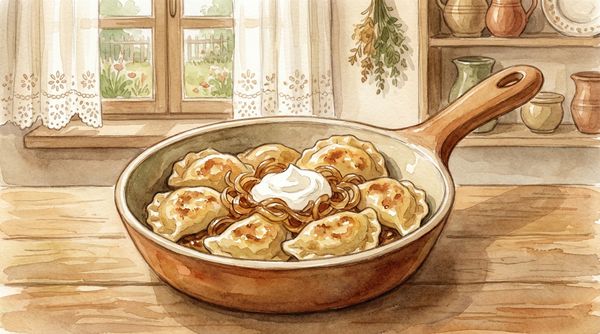
This is potato and cheese pierogi — ruskie — because this is where everyone starts. Once you can make these with your eyes half-closed, you'll start adjusting. That's the tradition working. Makes: about 40-50 pierogi (your grandmother would call this a warmup) For the dough: - 3 cups all-purpose flour - 1 large egg - 2 tablespoons sour cream - 1 tablespoon butter, melted - 3/4 cup warm water (not hot — warm, like bathwater) - A pinch of salt For the filling (ruskie — potato and cheese): - 5 medium potatoes, peeled and cubed - 1 cup farmer's cheese (or dry cottage cheese, pressed through a sieve — do not skip the pressing) - 1 medium onion, finely diced - 2 tablespoons butter - Salt and white pepper to taste For serving: - Butter — a generous amount, melted in a pan - 1 large onion, sliced and caramelised slowly until golden and sweet - Sour cream (cold, from the container, no embellishments) What you do: Make the dough first. Mound the flour on a clean surface. Make a well in the centre. Drop in the egg, sour cream, melted butter, and salt. Pour the warm water in slowly, working the dough from the inside out with your hands. Knead for 8-10 minutes until it's smooth and elastic — it should feel like an earlobe. Not sticky, not dry. Wrap it in plastic and let it rest for 30 minutes. The dough needs this. So do you. While the dough rests, make the filling. Boil the potatoes until they fall apart when you look at them. Drain completely. In a separate pan, cook the diced onion in butter over medium-low heat until soft and golden — not brown, golden. Patience. Mash the potatoes. Don't use a food processor — you'll get glue. A masher or a ricer. Mix in the farmer's cheese while the potatoes are still hot. Add the buttery onions. Season with salt and white pepper. Taste it. It should be rich and savoury and make you want to eat it straight from the bowl. If it does, the filling is right. Roll out the dough on a floured surface until it's about 1/8 inch thick — thin enough to be delicate, thick enough to hold. Cut circles with a glass or a round cutter, about 3 inches across. Place a small spoonful of filling in the centre of each circle. Not too much — you'll learn the amount by the third one. Fold the dough over into a half-moon. Press the edges together firmly with your fingers, then crimp with a fork. The seal matters. A pierogi that opens in the water is a pierogi that has failed its one job. Boil a large pot of salted water. Drop in 8-10 pierogi at a time — don't crowd them. They'll sink, then float. Once they float, give them another 2-3 minutes. Remove with a slotted spoon. In a large pan, melt butter and add the caramelised onions. Toss the boiled pierogi in the butter and onions until they get the faintest golden colour on the outside. Serve with a spoon of cold sour cream. That's it. That's everything.
The Gathering Note
You will make too many. This is correct. The extras go into the fridge, and tomorrow someone will find them cold and eat three of them standing at the counter at 11 PM and not tell anyone. This is also correct. Pierogi are not impressive food. They are not the dish you make to show off. They are the dish you make when you need your hands busy and your kitchen full of people who keep telling the same stories wrong. The dough is forgiving. The filling is simple. The folding is meditative. And somewhere around pierogi number thirty, when the flour is on your elbows and someone is laughing about something that happened in 1987, you'll understand why your grandmother's count was never wrong.