🍜 Pho — The Bowl That Finds You
Vietnam — from Hanoi street stalls to Saigon kitchens to every pho restaurant that became someone's lifeline
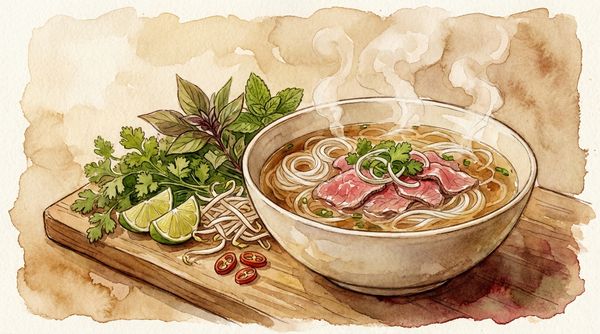
The Story
The broth takes hours. Sometimes a whole day. Beef bones, charred onion, charred ginger, star anise, cinnamon, cloves, fish sauce — simmered until the liquid is clear and deep and ancient-tasting, as if the pot has been remembering something it can't quite articulate.
Into a bowl goes a nest of rice noodles, soft and white. Slices of beef — raw, laid across the top, so thin they're nearly translucent. The boiling broth is ladled over everything, and the heat cooks the beef in the bowl, right there, turning it from pink to brown in seconds. Thinly sliced onion. A scattering of cilantro and Thai basil. A squeeze of lime. Sriracha if you want it. Hoisin if you must. Bean sprouts on the side.
The first sip of broth is the thing. It's the moment where the bowl stops being food and starts being something closer to an apology from the universe. I know today was hard. Here.
Pho (pronounced "fuh") is Vietnam's national dish, its cultural export, its ambassador. There are pho restaurants in every major city on earth, and in most of them, at any hour, someone is sitting alone with a bowl, not talking, just eating, and something in them is unknotting.
The Cultural Moment
Pho originated in northern Vietnam in the late 19th or early 20th century, likely in the Nam Dinh province or Hanoi. Its exact origins are debated — French colonial influence (the beef bones recall pot-au-feu), Chinese noodle traditions, and indigenous Vietnamese cooking all contributed. What is not debated is that pho became the defining food of Vietnam within a generation of its invention.
The two main styles are pho Bac (northern, from Hanoi) and pho Nam (southern, from Saigon). Northern pho is austere — a clearer broth, fewer toppings, the focus entirely on the purity of the soup. Southern pho is abundant — a richer broth, a bigger plate of herbs and garnishes, hoisin and sriracha on the table, bean sprouts piled high. Both camps believe their version is correct. Both are right.
After 1975, the Vietnamese diaspora carried pho to every corner of the world. In the United States, Australia, France, Germany — wherever Vietnamese refugees and immigrants settled, pho shops appeared. They became community centers. They became the place you went when you were homesick, or new, or lost. The bowl was always the same. The broth was always warm. And for the price of a bowl of soup, you could sit for as long as you needed.
The Recipe
Real pho broth takes time. This version is simplified but honest — the bones still simmer for hours, the spices still char, the broth still becomes something transcendent. Don't skip the charring. It's where the soul lives.
Serves: 4–6
For the broth:
- 3 lbs beef bones (knuckle and marrow bones — ask your butcher)
- 1 lb beef chuck or brisket (for slicing into the soup later)
- 2 large onions, halved
- 4-inch piece of fresh ginger, halved lengthwise
- 3 star anise
- 6 whole cloves
- 1 cinnamon stick
- 1 tablespoon coriander seeds
- 3 tablespoons fish sauce (adjust to taste)
- 1 tablespoon sugar
- Salt to taste
- 4 quarts water
Parboil the bones: cover with cold water, bring to a rolling boil for 10 minutes. Drain, rinse the bones, and scrub the pot. This removes impurities and is the secret to a clear broth.
Char the onion and ginger: place them cut-side down on a dry skillet or under a broiler until deeply blackened. This is where the pho flavor comes from — the char adds a sweet, smoky depth.
Toast the spices: in a dry pan, toast the star anise, cloves, cinnamon, and coriander seeds until fragrant — about 2 minutes. Put them in a spice bag or cheesecloth for easy removal.
Combine everything in a large pot. Add the water. Bring to a boil, then simmer gently for at least 3 hours — 6 is better. Skim any foam or fat. The broth should be clear and deeply aromatic.
Remove the beef chuck after about 90 minutes (when tender). Let cool, then slice thin for serving. Strain the broth, discard bones and spices. Season with fish sauce, sugar, and salt.
To serve:
- 1 lb dried flat rice noodles (banh pho), cooked according to package
- 1/2 lb eye of round or sirloin, sliced paper-thin (freeze for 30 minutes first to make slicing easier)
- Thinly sliced onion and scallion
The garnish plate (essential):
- Bean sprouts, Thai basil, cilantro, lime wedges, sliced jalapeño or bird's-eye chili, hoisin sauce, sriracha
Place noodles in bowls. Top with cooked beef slices and raw beef slices. Ladle boiling broth over everything — the raw beef will cook instantly. Add onion and scallion. Serve with the garnish plate.
The Gathering Note
There's a Vietnamese proverb: "Ăn cơm trước kẻng" — literally "eating rice before the bell." It means getting ahead of things. But pho doesn't work that way. Pho doesn't get ahead. Pho waits. It simmers. It takes as long as it takes.
When someone needs to be held and you have a day to give — an actual, full day — make pho. The bones simmer for hours. The house fills with star anise and ginger and charred onion. The broth goes from pale to golden to something that glows.
When you finally ladle it into a bowl and set it in front of the person who needs it, you're not handing them dinner. You're handing them a whole day you spent in the kitchen, thinking about them. The bowl knows.