🍵 Ochazuke — When the Day Has Been Too Long
Japan — from Kyoto tea houses to the kitchens of anyone who has ever come home too tired to cook
The Story
It's 11 PM. You just got home. The kitchen is dark. You don't have the energy to cook, the desire to order food, or the willpower to eat another convenience store onigiri standing up at the counter. You are, in the Japanese understanding, exhausted in the way that only work can make a person.
You put leftover rice in a bowl. You lay a few things on top — whatever is there. A piece of salmon from yesterday. Some pickled plum. A shake of nori. A few grains of rice seasoning. A pinch of wasabi if you want a little wake-up.
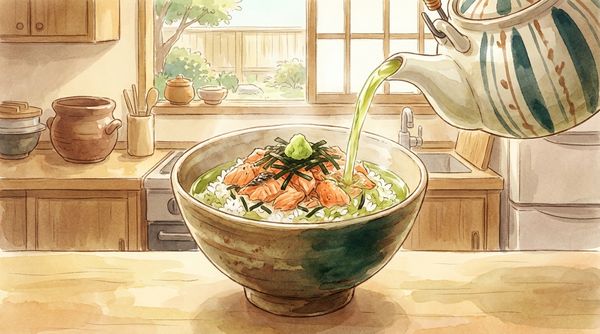
Then you pour hot green tea over everything.
That's ochazuke. Rice. Toppings. Hot tea. The end.
The tea softens the rice. The toppings release their flavors into the warm liquid. It becomes something between soup and rice and tea — a category that doesn't exist in Western cooking but makes perfect sense the moment you taste it. It's warm. It's simple. It takes three minutes. And it is exactly, precisely enough.
The Cultural Moment
Ochazuke (お茶漬け) literally means "submerged in tea" — ocha (tea) + zuke (submerged). It originated in the Heian period (794–1185) when people poured hot water over cold rice to make it palatable again. The tea version came later, as tea culture spread through Japan.
In Kyoto, ochazuke is elevated to an art form. There are restaurants that serve nothing else — an entire menu devoted to variations on rice-with-tea. Tai (sea bream) ochazuke, eel ochazuke, pickled vegetable ochazuke. The broth might be dashi instead of tea. The toppings might be exquisite.
But that's not what ochazuke is for. Ochazuke is for the end of the day. It's for the salaryman who missed dinner. The student studying late. The person who doesn't want to think about food but knows they should eat something. It's the Japanese answer to the universal question: what do I eat when I'm too tired to eat?
The Recipe
This is a framework, not a fixed recipe. Use what you have. The rice and the hot liquid are the only requirements. Everything else is invitation.
Serves: 1 (this is a solo meal — that's the whole point)
- 1 bowl of cooked rice (leftover is fine — even preferred, the firmer texture holds up better in the tea)
- Hot green tea — about 1 cup, brewed strong (or use dashi broth, or even hot water with a pinch of salt)
Toppings — choose what you have:
- A piece of grilled or baked salmon, flaked
- Umeboshi (pickled plum) — sour and salty, one is enough
- Nori (seaweed), torn into strips
- Tsukemono (Japanese pickles) — any kind
- Sesame seeds
- Wasabi — a small dab
- Furikake (rice seasoning) — if you have it, it's perfect here
- Scallion, thinly sliced
- A few drops of soy sauce
Put the rice in a bowl. Arrange the toppings on the rice — neatly if you're feeling composed, randomly if you're not. Pour the hot tea over everything. Let it sit for a moment — 30 seconds — while the tea soaks into the rice and the toppings start to release their flavors.
Eat it with chopsticks and a spoon. The chopsticks for the rice and toppings. The spoon for the broth at the bottom.
That's it. You made dinner. It took three minutes. You did enough.
The Gathering Note
Ochazuke is not a gathering meal. It's a solitary meal, and that's not a sad thing — it's a kind thing. It's the meal that meets you at the end of the day and says: you don't have to perform right now. You don't have to make something beautiful. You just have to eat.
The tea is hot. The rice is soft. The bowl is small enough to hold in both hands.
When it's just you tonight, this is enough. You are enough.