🌅 Nihari — The Cook Was Awake All Night
🇵🇰🇮🇳🇧🇩 Pakistan, India & Bangladesh — the dish cooked through the night for the one who leaves at dawn
The Story
The pot goes on before midnight.
That is the agreement, though no one wrote it down. The person leaving needs to eat before they go, and the going happens at first light, and nihari takes all night. So the fire is lit in the dark, the meat is lowered in, the spices are added, and the cook begins the long tending. Not the anxious kind of tending. The loving kind. The kind where you check the pot every hour not because it needs it but because the checking is the point — because being awake while someone else sleeps, stirring something fragrant and slow in the hours no one sees, is a form of language that has no other words.
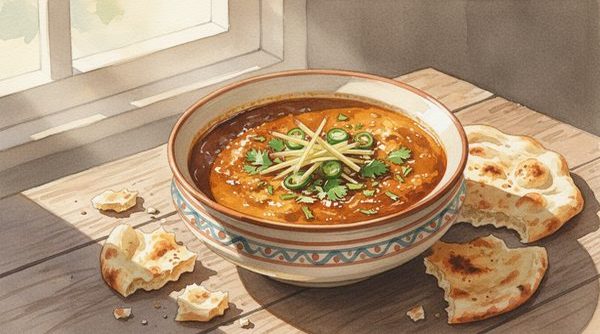
By the time the call to Fajr sounds across the neighborhood — the first prayer of the day, before the sky has decided between night and morning — the nihari is ready. The marrow has softened inside the bone until it gives at the gentlest pressure. The gravy has thickened around it, dark and complex, layered with a night's worth of heat and patience. The fried onions are piled alongside. The naan is fresh from the tandoor or the pan. The green chili is sliced. The ginger is julienned fine. The lemon is cut.
The one who is leaving sits down. Everyone else sits with them.
This is not a meal you eat quickly. This has never been a meal you eat quickly. You break the naan and dip it in. You find the bone and tilt it and let the marrow come. You squeeze the lemon. You eat slowly, because the leaving hasn't happened yet, and as long as the meal continues, the leaving hasn't happened yet.
When the bowl is empty, it is time to go.
The Cultural Moment
Nihari was born in the kitchens of the Mughal Empire, most likely in Old Delhi in the eighteenth century, when the empire was fading and the great mosques were full and the lanes around Jama Masjid were already filling with the smell of something slow-cooking before dawn. The name comes from the Arabic nahar — day — because this is the meal that meets the day as it begins. Historically, it was cooked overnight in enormous cauldrons by the vendors of Matia Mahal and Chitli Qabar, carried in clay pots to the men who came after morning prayers, hungry and awake before the city.
For two hundred years it was the food of Old Delhi: Muslim, working-class, magnificent. Then came 1947.
The partition of British India into India and Pakistan was one of the largest forced migrations in human history — an estimated fourteen million people displaced, crossing borders that had not existed the week before. Muslim families leaving Delhi and the surrounding areas carried almost nothing. They carried what was in their memory. Nihari was in their memory. It arrived in Karachi and Lahore not as a historical artifact but as a living recipe, made in the first cramped kitchens of the new country, tasting like the city they had left. Over the decades it became associated with Pakistan so thoroughly that many people there do not think of it as having come from anywhere. It came from here. It came with us. It is ours. And across the border in Old Delhi, in the same lanes where it was always made, it is also still theirs. Nihari is claimed on both sides of a border drawn through the middle of the dish.
Bangladesh knows nihari too, through the same Mughal inheritance and the same long migrations. The spice blend shifts slightly by region — the Pakistani version tends toward bone-in beef shanks and a thicker gravy; the Old Delhi version uses more fennel and dried ginger; some households use lamb. What does not shift is the structure: low heat, a long night, marrow, and the dawn.
The Recipe
Serves 6–8 — for a table that gathers before the light
For the meat:
- 3 lbs bone-in beef shank, cut into large pieces (ask the butcher to cut through the bone so the marrow is accessible)
- ¼ cup neutral oil or ghee
- 2 large onions, sliced thin and fried until deep golden
The nihari spice blend (or use a good store-bought nihari masala):
- 1 tablespoon coriander seeds, ground
- 1 teaspoon fennel seeds, ground
- 1 teaspoon cumin seeds, ground
- 1 teaspoon black pepper
- ½ teaspoon cardamom
- ½ teaspoon cloves, ground
- ½ teaspoon dried ginger powder
- ½ teaspoon cinnamon
- ½ teaspoon turmeric
- ¼ teaspoon nutmeg
- 1 bay leaf
For the gravy:
- 3 tablespoons whole wheat flour (atta) or plain flour, mixed with ½ cup water into a smooth paste
- 1½ teaspoons salt, more to taste
- 4–5 cups water
To serve:
- Fresh ginger, peeled and julienned fine
- Green chilies, sliced
- Fresh coriander, roughly chopped
- Fried onions (reserved from cooking)
- Lemon wedges
- Warm naan or crusty bread
Start with the fried onions. Slice both onions thin, fry them in the oil over medium heat until they are deeply golden and beginning to crisp — this takes twenty to twenty-five minutes and cannot be rushed. Remove half and set them aside for serving. Leave the rest in the pot.
Add the meat to the pot with the remaining fried onions. Brown it on all sides over high heat. Add the spice blend and stir to coat. Let the spices cook in the oil for two minutes until fragrant. Add the salt and the water — enough to cover the meat generously. Bring to a boil, then reduce the heat to the lowest possible simmer.
Cover the pot. Let it cook. This is where the night begins.
For the first hour, leave it alone. After the first hour, check: the liquid should be at a gentle murmur, not a boil. Adjust the heat if needed. Stir gently once. Cover again. Check again in another hour. This continues through the night — five to six hours at minimum, seven or eight if you have them. The marrow will soften. The collagen in the shank will dissolve into the gravy, thickening it naturally.
In the final thirty minutes: mix the flour into its water paste until completely smooth, then stir it slowly into the pot. This thickens the gravy to the consistency it should be — coating the back of a spoon, deep and glossy. Taste and adjust the salt. The gravy should taste like many things at once.
Serve in deep bowls with the bone pieces in the center, the marrow still inside. Scatter the reserved fried onions over the top. Add the fresh ginger, green chili, and coriander. Put the lemon wedges and warm naan on the table.
To eat: break the naan and use it. Find the bone. Tilt it. Let the marrow come out. This is the part you stayed awake for.
"You'll know it's ready when the gravy has gone dark and the spoon leaves a trail through it that fills in slowly, the meat has pulled back from the bone without being asked, and the kitchen smells like it has been tended all night, which it has."
The Gathering Note
There is a particular kind of love that expresses itself through lost sleep. The person leaving will not see the midnight check, or the 2am stir, or the moment at 4am when the gravy is tested and adjusted and covered again. They will only see the bowl that appears as the sky lightens. But they will taste the hours. Not consciously — the way you taste a twelve-hour broth without knowing that's what you're tasting — but somewhere below the flavor, in whatever part of a person recognizes when they have been cared for through the night.
Nihari crossed a border in 1947 inside the memories of people who lost almost everything else. It arrived on the other side still warm, still itself, still made the same way it was always made. This is what food does when it matters enough: it travels. It crosses whatever line is drawn. It finds a new kitchen and makes itself at home, and thirty years later the children of those kitchens do not think of it as having come from anywhere, because it came from here, from home, from the pot that was on before midnight.
The bone gives everything it has. The cook stays awake. The leaving happens at dawn. And the meal, which asks for so much time, gives back exactly that much in return.