🍳 Nasi Goreng — The Midnight Fried Rice
Indonesia — and every kitchen where one person, one pan, and yesterday's rice become a perfect midnight meal
The Story
It's late. The house is quiet. Everyone else has gone to bed, or gone home, or was never here to begin with. It's just you, the kitchen, and the container of cold rice in the fridge that you made yesterday and forgot about.
This is the moment nasi goreng was invented for.
The name means "fried rice" — nasi is rice, goreng is fried — and that simplicity is the whole point. Nasi goreng is what happens when you open the fridge at midnight and decide that what's there is enough. Cold rice. An egg. Some soy sauce. A little garlic. Maybe a shallot. Maybe some chilli. Whatever you have. The pan heats up, and within ten minutes you have a plate of food so satisfying that you'll eat it standing at the counter in the half-dark and wonder why you ever bother with anything more complicated.
In Indonesia, nasi goreng is not a midnight secret. It is the national dish — literally. In 2014, CNN readers voted it the second-best food in the world. It appears on every street corner, at every warung (the small family-run food stalls that are the backbone of Indonesian eating), at every hotel breakfast buffet from Jakarta to Bali, and at every hour of the day and night. Breakfast nasi goreng comes with a fried egg on top. Lunch nasi goreng might have chicken or prawns. Dinner nasi goreng is whatever was left over. Midnight nasi goreng is the truest version — just you and the pan and the particular alchemy of high heat meeting cold rice.
Because cold rice is essential. This is the secret that every Asian grandmother knows and every cooking show eventually discovers: fresh, hot rice will not fry. It's too wet, too sticky. It steams in the pan and turns to mush. But rice that spent the night in the fridge? The grains are dry. Separate. Firm. When they hit the hot oil, they don't clump — they dance. Each grain gets its own moment with the heat, its own coat of sauce, its own tiny crust. The result is rice that's simultaneously soft and slightly chewy, flavoured all the way through, with some grains almost caramelised where they sat against the pan longest.
The flavour comes from kecap manis — Indonesian sweet soy sauce, which is thicker and darker and sweeter than regular soy sauce, almost like soy-flavoured molasses. It stains the rice a deep mahogany and gives it that distinctive sweet-savoury depth that you cannot replicate with any substitution (though you can try: regular soy sauce plus a spoonful of brown sugar gets you in the neighbourhood, if not the exact address).
But the real soul of nasi goreng is the bumbu — the spice paste. Shallots, garlic, chilli, and shrimp paste (terasi), ground together with a mortar and pestle or a quick blitz in a food processor. The shrimp paste is the ingredient that foreigners are most afraid of and most grateful for once they taste it. It's pungent — almost aggressively so when raw. But cooked in hot oil for thirty seconds, it transforms into something deeply savoury, the flavour equivalent of someone turning up the bass on a song you already liked.
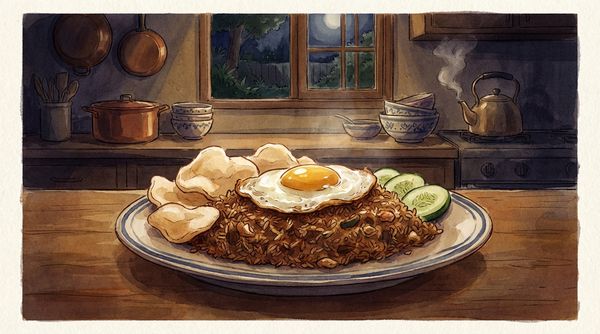
The egg goes on top. Fried. Runny yolk. This is the crown of the dish — you break it with your fork and the yolk runs into the rice and everything becomes richer. A few slices of cucumber on the side. Some kerupuk — the shrimp crackers that shatter when you bite them. Maybe some sliced tomato. Maybe nothing else at all.
You eat it alone, at midnight, and it is completely enough.
The Cultural Moment
Nasi goreng exists because Indonesia is a rice culture where waste is unthinkable. In a country of 270 million people spread across 17,000 islands, rice is not a side dish. It is the centre of the plate, the centre of the meal, the centre of life. The Indonesian word for eating — makan — is essentially synonymous with eating rice. A meal without rice is not, in the cultural grammar, a meal.
Leftover rice, then, is not a problem. It is a resource. Nasi goreng is the most elegant solution to leftover rice ever devised — not because it's complex, but because it's immediate. It takes five to ten minutes. It uses whatever is in the kitchen. It transforms day-old rice into something better than it was when it was fresh. In a culture where rice is sacred and waste is shameful, nasi goreng is both practical and philosophical: nothing is thrown away, everything is given another chance.
The warung version of nasi goreng is its own institution. Every Indonesian city, town, and village has warungs — some with walls, some just a cart and a chair — where a single cook produces nasi goreng over a charcoal or gas burner with the kind of wok control that takes years to develop. The wok hei — the breath of the wok, the smoky, charred flavour that comes from cooking at extreme heat — is what separates warung nasi goreng from the home version. A good warung cook can make fifty plates in an hour and each one will taste like it was made just for you.
The dish also carries the full diversity of Indonesia in its variations. In Java, it's sweeter, heavier on the kecap manis. In Sumatra, it's spicier, with more raw chilli. In Bali, it might include sambal matah — a raw shallot and lemongrass relish that adds a bright, sharp counterpoint. In Padang, it arrives with a constellation of side dishes. Every island, every city, every family has a version. The base is the same. The expression is infinite.
For Indonesians abroad — in the Netherlands (where nasi goreng became a Dutch comfort food through colonial history), in Australia, in Singapore, in wherever the diaspora landed — making nasi goreng is the fastest way back. The smell of shallots and terasi hitting hot oil is geography compressed into thirty seconds. It is the smell of every warung you ever sat at, every midnight kitchen you ever stood in, every plate you ever ate that cost less than a dollar and fed you better than anything else that week.
The Recipe
This is the midnight version — the one for when it's just you and the cold rice. Simple, fast, deeply satisfying. If you want to add chicken or prawns or vegetables, do — but the plain version, with just an egg on top, is the one that matters at 1 AM.
Serves: 1 (nasi goreng scales up easily, but at midnight, it's almost always for one)
What you need: - 2 cups cold cooked rice (white jasmine rice, day-old, from the fridge — this is non-negotiable) - 2 tablespoons vegetable oil (or more — the wok wants to be well-oiled) - 1 egg - 2 tablespoons kecap manis (Indonesian sweet soy sauce — find it in an Asian grocery store; it changes everything) - 1 tablespoon regular soy sauce - Salt to taste
For the bumbu (spice paste): - 3 shallots (or 1 small red onion), roughly chopped - 2 cloves garlic - 2-3 bird's eye chillies (or 1 red chilli if you want less heat — adjust to your midnight bravery) - 1/2 teaspoon shrimp paste (terasi) — optional but transformative (if you don't have it, add a splash of fish sauce instead)
On the side: - Sliced cucumber - Sliced tomato - Kerupuk (shrimp crackers) — if you have them - Sambal (chilli sauce) — if you want more heat - Fried shallots — if you're feeling generous with yourself
What you do:
Make the bumbu. If you have a mortar and pestle, pound the shallots, garlic, chillies, and shrimp paste into a rough paste — it doesn't need to be smooth, just broken down. If you have a small food processor, pulse it a few times. If you have neither, just mince everything as finely as you can. The flavour will still be there.
Heat the oil in a wok or the largest pan you have over high heat. The pan needs to be hot — properly hot, the kind of hot where a drop of water skitters and evaporates on contact. This is where the flavour lives.
Add the bumbu. Stir-fry for 30 seconds to 1 minute until it's fragrant and the raw smell of garlic and shrimp paste has turned into something that smells like a warung at midnight. It happens fast.
Add the cold rice. Break up any clumps with your spatula and spread the rice across the surface of the pan. Let it sit for 20-30 seconds without stirring — this is how you get the slightly charred, smoky edges. Then toss it. Let it sit again. Toss again. You're building layers of colour and flavour with each contact with the pan.
Add the kecap manis and soy sauce. Toss everything together until the rice is evenly coated — it should turn a deep brown. Taste. Add salt if needed. The kecap manis is sweet, the soy sauce is salty, the shrimp paste is umami — together they should hit every note.
Push the rice to one side of the pan. Crack the egg into the empty space. Fry it until the whites are set and the edges are crispy, but the yolk is still runny. (Or scramble the egg into the rice if you prefer — both ways are correct. The fried egg on top is more beautiful. The scrambled egg mixed in is more comforting. Choose your midnight.)
Slide the rice onto a plate. Place the egg on top. Arrange the cucumber and tomato alongside. Add kerupuk if you have them. Put the sambal within reach.
Eat. Standing or sitting. It doesn't matter. The kitchen is yours. The rice is perfect. The midnight is exactly what it needed to be.
The Gathering Note
Nasi goreng is not gathering food. It is the opposite of gathering food. It is the food for when everyone has gone and it's just you, and that's fine, and the kitchen is quiet, and the fridge has rice.
There is a particular kind of comfort in cooking for yourself at midnight. Not because you have to, but because you can. Because you know exactly what you want, and what you want is this: a hot pan, cold rice, an egg, and ten minutes. Nobody to impress. Nobody to feed. Just the sound of rice meeting heat and the smell of something becoming exactly what you needed.
Some foods are for the full table. Nasi goreng is for the empty one. Both are the table.