🥣 Matzo Ball Soup — Medicine That Isn't Medicine
Jewish diaspora — from Eastern European shtetls to every kitchen where a grandmother insists you eat
The Story
You're sick. Or you're sad. Or you're fine but your grandmother doesn't believe you.
The soup arrives anyway.
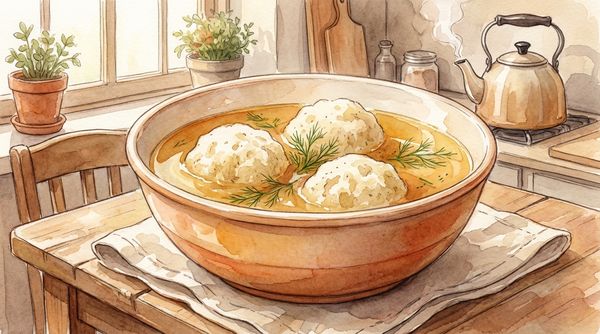
It arrives in a pot that's too big for one person because Jewish grandmothers don't cook for one person — they cook for the possibility that anyone might show up. The broth is golden. Not yellow — golden. There's a difference. Yellow is turmeric or food coloring. Golden is what happens when you simmer a whole chicken with onions and carrots and celery and dill for four hours until the liquid looks like something precious was dissolved in it.
And floating in this golden broth are the matzo balls. Round. Soft or firm — and this is where families divide, permanently and passionately. Floaters or sinkers. Floaters are light, fluffy, cloud-like — they dissolve on your tongue. Sinkers are dense, firm, satisfying — they sit in your stomach and stay. Every family has a position. Every family is certain they are correct. No family has ever changed sides.
Your bubbe (grandmother) doesn't ask if you want soup. She doesn't ask if you're hungry. She sets the bowl in front of you and says "Eat." That's it. One word. It contains within it an entire philosophy of care: I cannot fix what is wrong. I cannot take the fever or the grief or the loneliness. But I can feed you. So I will feed you. Eat.
The Cultural Moment
Matzo ball soup is Ashkenazi Jewish comfort food at its most essential. It descends from the kneydlakh of Eastern Europe — dumplings made from matzo meal, the ground-up unleavened bread of Passover. During Passover, when leavened bread is forbidden, matzo meal becomes the flour of everything. Matzo ball soup is the holiday dish that escaped the holiday. It became everyday food because people refused to wait for Passover to eat something that good.
The soup itself — the golden chicken broth — is older than the matzo balls. Goldene yoykh (golden broth) is a foundational dish of Ashkenazi cuisine, carried from Lithuania and Poland and Ukraine and Romania to wherever Jewish families fled. The broth crossed oceans. The recipe stayed in the hands.
In Jewish mourning tradition, the first meal after a funeral (seudat havra'ah, the meal of consolation) is brought by friends and neighbors, not prepared by the mourning family. Soup is almost always part of this meal. You don't ask the grieving person what they want. You bring what heals. And what heals, every time, is a bowl of golden broth with something soft floating in it.
The Recipe
This is the full version — broth from scratch, matzo balls from scratch. If you use store-bought broth, your bubbe will know. She won't say anything. But she'll know.
Serves: 6–8 (there will be leftovers — that's the design)
For the broth:
- 1 whole chicken (about 4 lbs)
- 2 large onions, halved (skin on — it adds color)
- 4 carrots, cut into large chunks
- 4 celery stalks with leaves
- 1 parsnip, peeled and halved (the secret ingredient — adds sweetness)
- Big bunch of fresh dill
- Big bunch of fresh flat-leaf parsley
- 10 whole black peppercorns
- 1 tablespoon salt
- About 4 quarts cold water
Put everything in your biggest pot. Cover with cold water. Bring to a boil, then reduce to the gentlest simmer. Skim the foam. Simmer for 3–4 hours. Strain. The broth is the treasure.
For the matzo balls:
- 4 large eggs
- 1/4 cup schmaltz (chicken fat) or vegetable oil
- 1 cup matzo meal
- 1 teaspoon salt
- 2 tablespoons seltzer water (for floaters — skip for sinkers)
Beat eggs and schmaltz. Add matzo meal, salt, and seltzer if using. Mix until just combined. Refrigerate 30 minutes. Wet your hands, form walnut-sized balls. Boil in salted water (not the broth) for 30–40 minutes.
Ladle broth into bowls. Add 2–3 matzo balls. Fresh dill on top. Say "Eat."
The Gathering Note
There's a Yiddish saying: "Worries go down better with soup."
That's the whole philosophy. Not that soup fixes worry. Not that the bowl erases whatever brought you to the table. Just that the worry goes down better — more gently, more bearably — when there's something warm and golden in front of you.
When someone needs to be held and you don't know how to hold them — when the words aren't right and the situation can't be fixed and all you have is your hands and a kitchen — make this soup. Not because it's medicine. Because it's the closest thing to sitting beside someone and saying nothing and being enough.