🍛 Langar — The Kitchen That Never Closes
🇮🇳 Sikh tradition — and every Gurdwara on earth, where the door is open, the dal is on, and no one who is hungry is turned away
The Story
You don't need to be Sikh. You don't need to be anything.
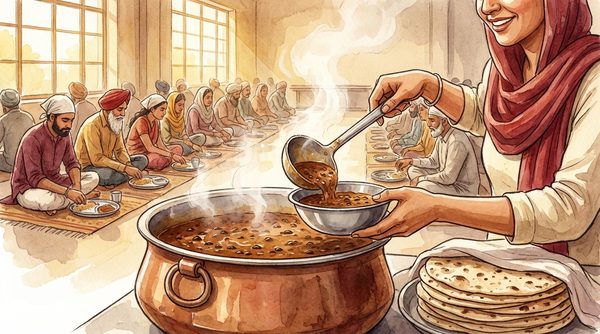
You walk through the door. You wash your hands. You cover your head — there is cloth at the entrance if you don't have anything — and you walk into the langar hall and you sit down on the floor. Not at a table. The floor. In a row with everyone else, because on this floor there are no separate tables and there is no separate seating and there is no section for the people who matter more.
A volunteer — a sevadar, someone who came here this morning to serve, not for pay, not for recognition, as an act of love — comes down the row with a pot of dal. They ladle it into your bowl. Another sevadar comes with roti, fresh from the griddle, still warm, and places it in your hands. Another comes with sabzi — vegetables, cooked simple and well. If there is kheer today, a sevadar brings that too.
You eat. When your bowl is empty, someone fills it again. No one asks your name. No one asks where you are from or what you believe or why you came. The only question anyone asks is: do you need more?
This is langar. It has been happening every day, at Gurdwaras around the world, for five hundred years. The kitchen has never closed.
Not during wars. Not during famine. Not during the Partition of 1947, when millions were displaced and dying, and the Gurdwaras opened their langars wider than they had ever been opened and fed anyone who appeared at the door regardless of religion — Hindu, Muslim, Sikh, it did not matter, the dal was for everyone. Not during COVID-19, when the world went still, and Gurdwaras across India, Britain, Canada, the United States expanded their langar operations and sent food into the streets, and asked nothing in return.
The kitchen has never closed. This is not a metaphor. This is a fact with five hundred years behind it.
The Cultural Moment
Langar was established by Guru Nanak Dev Ji — the founder of Sikhism — in the late 15th century. He did not establish it as a charity. He established it as a statement.
India at that time was organized by caste — a rigid hierarchy that determined who you could eat with, who you could sit beside, whose hands could prepare your food. The higher your caste, the more restrictions surrounded your eating. The lower your caste — or if you had no caste at all — the more invisible you were at every table.
Guru Nanak said: no. Everyone sits together. Everyone eats the same food. There is one floor and everyone sits on it. The word for this practice is pangat — row — because the rows have no order of importance. The first person to sit is not more important than the last. The richest person in the city sits beside the person who arrived with nothing, and they eat from the same kitchen, served by the same hands.
The food is always vegetarian, not because Sikhs are required to be vegetarian, but because vegetarian food can be eaten by everyone. The langar is designed so that no one's beliefs or restrictions can be used to exclude them. The food is simple enough that no one feels like a guest of a tradition that isn't theirs. The meal is not a demonstration of Sikh cooking. It is a demonstration of Sikh values: sarbat da bhala — the welfare of all.
The word langar itself comes from the Persian for "anchor." The community kitchen is what anchors the Gurdwara to the earth, to the neighborhood, to every person who walks through the door hungry.
In the 16th century, the Mughal Emperor Akbar arrived at the Gurdwara of Guru Ram Das (the fourth Sikh Guru) seeking an audience. He was told: first, sit in the pangat and eat langar. The Emperor of the Mughal Empire — one of the most powerful men on earth — sat on the floor with everyone else and ate dal and roti from the same kitchen as the farmer and the trader and the pilgrim. He ate. Then he had his audience. The meal before the meeting was not optional. It was the point.
Today, the Harmandir Sahib — the Golden Temple in Amritsar, the holiest site in Sikhism — serves between 50,000 and 100,000 meals every single day. The kitchen runs in shifts, around the clock. The volunteers — sevadars — come at every hour to knead dough, stir dal, roll roti, wash dishes. There are machines now that help with some of the roti, but there are still hundreds of hands rolling bread by hand every day because the making is part of the practice. The cooking is seva. The serving is seva. The washing up is seva. Every step is understood as an act of devotion, not labor.
The langar is free. It has always been free. It is funded by donations — anyone can contribute money, or ingredients, or their time. The tradition is that when you donate to the langar, you do not give because you feel sorry for the people who need it. You give because feeding people is a spiritual practice, and you want the practice.
In Gurdwaras in London and Toronto and Los Angeles and Nairobi and Singapore, the langar runs every day. The food is adapted to local ingredients — the dal might taste slightly different in Surrey than in Amritsar — but the structure is identical. Sit on the floor. Eat together. Everyone equal. No one turned away.
For Sikhs, the langar is one of three pillars of practice alongside Naam Japna (meditation on God's name) and Kirat Karni (honest work). Feeding the stranger is not peripheral to the faith. It is the faith, made edible, served in a bowl.
The Recipe
This is langar dal — the black lentil dish that appears in every Gurdwara langar, slow-cooked until it is soft and deep and almost endlessly comforting. It is sometimes called dal makhani in restaurants, but langar dal is simpler, less rich, made to feed hundreds. This version is scaled for a family but keeps the spirit: it asks for time, not technique.
Serves: 8–10
What you need:
- 2 cups whole black lentils (urad dal, also called black gram — available at Indian grocery stores)
- 1/2 cup kidney beans (rajma), soaked overnight
- 10 cups water
- 1 tablespoon salt
For the tadka (the tempering that brings it alive):
- 3 tablespoons ghee or oil
- 1 large onion, very finely diced
- 6 cloves garlic, minced
- 1 tablespoon fresh ginger, grated
- 2 medium tomatoes, pureed or very finely chopped
- 1 teaspoon cumin seeds
- 1 teaspoon coriander powder
- 1/2 teaspoon turmeric
- 1/2 teaspoon red chili powder (adjust to taste)
- Salt to taste
- Fresh cilantro, chopped
For the roti (the bread that completes the meal):
- 3 cups whole wheat flour (atta)
- 1 teaspoon salt
- Water, added gradually (about 1 cup, until the dough is soft and pliable)
- Ghee or butter, for brushing
Cook the dal: Wash the black lentils and soaked kidney beans until the water runs clear. Place them in a large, heavy-bottomed pot with the water and salt. Bring to a boil, then reduce to the lowest possible simmer. Cover and cook for 2 to 3 hours, stirring occasionally. The lentils should become completely soft and begin to break down, thickening the broth. If the pot gets too dry, add more water. The longer it cooks, the deeper it becomes. In the Gurdwara, this dal simmers for hours before service. Patience is the ingredient that costs nothing.
Make the tadka: In a heavy pan, heat the ghee. Add the cumin seeds and let them crackle for 30 seconds. Add the onion and cook on medium heat, stirring often, for 15 to 20 minutes until deeply golden — not burnt, but truly caramelized, which is what gives langar dal its sweetness beneath the savory. Add the garlic and ginger and cook for 2 minutes. Add the tomatoes and all the dry spices. Cook, stirring, for 8 to 10 minutes until the tomatoes are completely cooked and the oil begins to separate from the sides.
Pour the tadka into the dal pot. Stir thoroughly. Taste for salt. Simmer everything together for another 20 minutes. The dal will become darker, richer, more unified. Add water if you want it thinner, let it cook uncovered if you want it thicker. Finish with fresh cilantro.
Make the roti: Mix the flour and salt. Add water gradually, mixing until a soft dough forms. Knead for 5 to 8 minutes until smooth. Let the dough rest for 20 minutes under a damp cloth. Divide into golf ball-sized portions. Roll each one on a floured surface into a thin, rough circle. Cook on a hot dry pan or tava for about a minute per side until brown spots appear. Place directly on the flame for a few seconds to puff up, if you have a gas burner. Brush with ghee immediately.
"You'll know the dal is ready when it coats the back of your spoon and tastes like it has been on the stove since morning — because it has."
The Gathering Note
There is a word in Sikhism — seva — that is usually translated as "selfless service." But the translation loses something. Seva is not self-sacrifice. It is not performing a duty. It is understanding, at a level deeper than thought, that serving others is the same as serving God — that the stranger in the pangat is not a recipient of your charity but a reflection of the divine, and feeding them is a privilege.
This changes everything about how the langar is run. The sevadars don't serve you with the dignity of the generous giving to the needy. They serve you the way you serve someone you love. The dal is poured into your bowl and the eyes of the sevadar meet yours and there is no hierarchy in the room, no debt created, nothing owed. You eat. You are fed. That is all.
For people who have been made to feel like a burden when they ask for help — who have stood in lines where their hunger was processed as a problem to be managed — the langar is something else entirely. You walk in not as a recipient of someone's kindness but as a guest of the community, which has been expecting you, which set your place before you arrived, which will fill your bowl as many times as you need.
The meal is simple. Dal, roti, perhaps something sweet. It is not spectacular food. It is the food that says: you are here, you are hungry, you are welcome, and none of these three things require explanation.
The kitchen has been open for five hundred years. It will be open tomorrow. Whenever you need it, it will be there.
Sit on the floor. Eat.