🫖 Kahvaltı — The Morning That Refuses to Rush
Turkey — from Istanbul balconies to wherever someone decides that morning deserves three hours
The Story
It takes an hour to set the table and three hours to leave it.
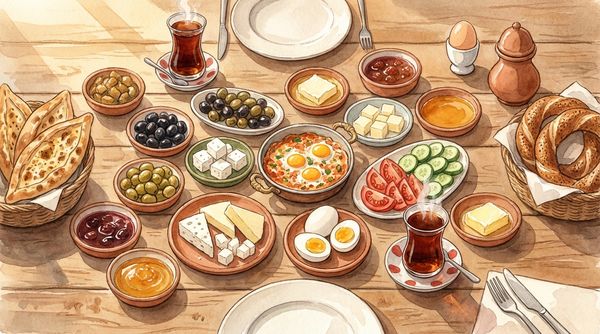
That's a Turkish breakfast. Not a meal — a philosophy. The table is covered in small plates: white cheese and aged cheese and cheese with herbs. Olives — black and green, from different regions, each one tasting like a different argument about which valley gets the most sun. Tomatoes and cucumbers sliced thick because this isn't a garnish, this is the backbone. Honey still in the comb. Clotted cream so thick you cut it with a knife. Preserves — sour cherry, rose petal, fig, quince — each one in its own small dish, each one made by someone's mother or someone's neighbor or someone at the village market who has been making this preserve for forty years.
There are eggs. Menemen — scrambled slowly with tomatoes and green peppers until everything melts together into something that is not scrambled eggs anymore, it's a painting. Or sucuklu yumurta — eggs fried with spicy beef sausage that pops and sizzles.
There is bread. Always bread. Simit from the cart — the sesame-crusted ring that is Istanbul's heartbeat. Or village bread, thick and chewy, torn by hand.
There is tea. Çay. Served in tulip-shaped glasses so you can see the color — dark amber, almost red. The tea never stops. When your glass is empty, someone fills it. When that glass is empty, someone fills it again. The tea is the clock. As long as there is tea, the morning continues.
Nobody is going anywhere.
The Cultural Moment
Kahvaltı literally means "before coffee" — kahve altı — which is ironic because a Turkish breakfast rarely involves coffee. The coffee comes after. The breakfast comes first, and first can take all morning.
In Turkish culture, breakfast is the most social meal. Weekend breakfast — serpme kahvaltı, the "spread breakfast" — is a communal event. Families do it at home. Friends do it at kahvaltı salonu — breakfast salons that serve nothing else, open from morning until afternoon, because the morning is allowed to become afternoon.
The spread is the thing. Twenty, thirty, sometimes forty small dishes. No single item is the star. The table itself is the star. The abundance isn't about excess — it's about variety. Every plate is different. Every bite changes the conversation.
This is a deliberate rejection of speed. In a world that invented fast food and efficient meal prep and eating at your desk, Turkish breakfast says: no. The morning is not a transition. The morning is the destination. Sit down. Stay. The tea is hot. The cheese is good. Whoever you need to be later, you don't need to be them yet.
The Recipe
You don't cook a Turkish breakfast. You assemble it. The work is in the gathering — buying the right cheese, choosing the right olives, making the menemen fresh. Think of it as curating a morning.
Serves: As many as arrive
The Essentials:
- White cheese (beyaz peynir — similar to feta)
- Aged cheese (kaşar — semi-hard, slightly sharp)
- Black olives and green olives
- Tomatoes, sliced thick
- Cucumbers, sliced thick
- Honey (in the comb if you can find it)
- Clotted cream or thick cream cheese (kaymak — mascarpone is a friend)
- Butter
- Preserves — at least two kinds
- Bread — simit or any crusty bread, torn not sliced
- Tea — black tea, strong, served in clear glasses
The Menemen:
- 3 tablespoons butter or olive oil
- 1 large onion, diced
- 2 green peppers, diced
- 4 ripe tomatoes, roughly chopped
- 1 teaspoon Turkish pepper flakes (pul biber)
- 4 eggs
- Salt to taste
Heat butter, cook onion until soft, add peppers, then tomatoes and pepper flakes. Cook until the tomatoes break down — 10 to 15 minutes. Crack the eggs in and stir gently. Cook until just set. Serve from the pan.
Set the table. Every item gets its own small plate. The menemen arrives last, hot from the stove.
Make tea. Make more than you think you need. Then make more.
Sit down. Don't plan the morning.
The Gathering Note
There is a Turkish expression: "Kahvaltı yapmak" — literally, "to do breakfast." Not "to eat" breakfast. To do it. Because a Turkish breakfast is something you participate in, not something you consume.
The table is set. The tea is poured. Someone is arguing about whether the cheese is better this week than last week. Someone else is putting honey and cream on bread and not talking to anyone because they are having a private moment with that bread and they should not be disturbed.
This is what Sunday morning looks like when you let it be what it wants to be. Not a transition. Not a prelude. The thing itself.
Wherever you are, the morning can take as long as the morning wants.