🍚 Jollof Rice — The Pot That Starts the Argument
West Africa — from Lagos to Accra to Dakar to every kitchen where the diaspora gathers

The Story
Nobody agrees on jollof rice. That's the point.
Nigerians say theirs is the original. Ghanaians say theirs is better. Senegalese say both of them are wrong, that thiéboudienne — the Wolof ancestor of jollof — started everything. This argument has been happening for generations. It happens at dinner tables, on social media, at weddings, at funerals, in the comments section of every recipe video ever posted. It is the longest-running food debate in the world, and nobody wants it to end. Because the argument is the love.
The rice is always long-grain. The base is always tomato — rich, deep, stewed down until the tomatoes stop being a sauce and start being something closer to a promise. The onions are always there. The peppers bring heat — scotch bonnet in Nigeria, a gentler chili in Ghana, whatever grows in the garden wherever you are. And then it diverges. In Nigeria, the rice is cooked directly in the tomato stew, absorbing everything, turning red-orange and sticky at the bottom where the party jollof crust forms — the smoky, slightly burnt layer that people will fight over. In Ghana, the rice is often par-cooked first, then finished in the sauce, and the basmati gives it a different character — lighter, more separate, each grain distinct.
When someone comes home — truly comes home, from far away, from something hard — the first thing that happens in a West African kitchen is the pot comes out. Not a small pot. The big one. The one that feeds twelve even when there are only four people. Because someone might stop by. Someone always stops by.
🍚 Biryani — The Celebration Pot, Layered and Sealed
India and Pakistan — from Hyderabad to Lahore to every wedding feast that required a miracle worker and a pot
The Story
Biryani doesn't cook like other rice. It seals itself.
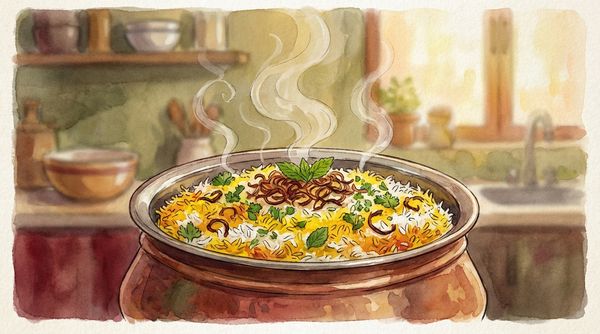
The pot comes out — always the biggest one, always the one with the lid that fits tight enough to trap steam. The rice doesn't go in first. Neither does the meat. First comes the onions, caramelized until they're dark and sweet, more memory than vegetable. Then the yogurt-marinated meat — chicken or goat or lamb, whatever the occasion calls for. Then the half-cooked rice, scattered on top like prayer. Then more caramelized onions. Then saffron soaked in milk, poured like gold. Ghee — always butter clarified into its essence. A seal made of dough, pressed around the rim of the lid. Mint leaves and cilantro scattered between the layers. And then: silence.
The pot goes on heat just long enough to create steam. Then it sits. Twenty minutes, thirty, forty. The dough seal browns and hardens. The steam circulates inside — the only world. The rice doesn't absorb broth like other rice. It absorbs the flavors of everything it touches: the meat, the yogurt, the ghee, the saffron, the spice. Every grain ends up tinted, flavored, complete.
When the seal is broken — and only after the time is right — the aroma that escapes is the smell of a celebration before it started.
The Cultural Moment
Biryani is the rice of major life events. Weddings, especially. Hyderabadi biryani is considered the apotheosis — the Nizams of Hyderabad perfected it in the 16th century, and it hasn't needed improvement since. Every region of India and Pakistan claims its own version and defends it with the intensity of someone protecting their ancestors. Kolkata biryani is wetter. Lucknow biryani — dum pukht, slow-cooked — is drier, more separate. Pakistani biryani can have a sweetness that seems impossible until you understand it's not sweetness, it's memory.
The sealing of the pot is not accidental. It's ritual. The dough seal isn't just technique — it's a statement that what happens inside this pot is separate from the outside world. The steam that circulates is trapped, recirculated, deepened. Nothing enters. Nothing escapes. For those forty minutes, the biryani is becoming itself in isolation.
In the diaspora, biryani is what gets made for the occasions that matter. For homecomings. For the announcement of good news. For the moments when you want to say, "This person is important enough that I spent hours on this." The patience required is not a burden. The patience is the point.
The Recipe
This is a simplified home version — Hyderabadi style. The traditional wedding version involves more steps, more patience, and a cook who understands the rice and the steam the way musicians understand their instruments.
Serves: 6–8
For the meat: - 2 lbs chicken (cut into pieces) or mutton (cut into 2-inch pieces) - 1 cup yogurt - 2 tablespoons ginger-garlic paste - 1 tablespoon chili powder - 1/2 teaspoon turmeric - Salt to taste - 2 tablespoons vegetable oil - Marinate for at least 30 minutes (overnight is better)
For the rice: - 2 cups basmati rice (long-grain, high quality) - Water for soaking and cooking - 4–5 green cardamom pods - 3–4 black cardamom pods (if available) - 4 cloves - 1 inch cinnamon stick - 1 teaspoon whole cumin seeds - Salt to taste
For the biryani: - 1/2 cup ghee (clarified butter) - 4 large onions, thinly sliced - 1/4 cup cilantro, chopped - 1/4 cup mint, chopped - 1 teaspoon saffron strands - 1/2 cup warm milk - 2–3 potatoes, cut into chunks and fried until golden (optional but traditional) - Extra salt and spice to taste - Dough for sealing the pot (2 cups flour, 1/2 cup water, 1 teaspoon salt — make a stiff dough)
Preparation:
Soak the saffron in warm milk and set aside. Soak the rice for 30 minutes.
Heat ghee in a heavy-bottomed pot. Add the sliced onions in batches and fry on medium-high heat until dark brown and crispy — this takes time, 15–20 minutes. Do not rush. Remove the onions with a slotted spoon and drain on paper towels. Save the ghee. These caramelized onions are half the magic.
In the same pot (with some of the ghee), layer: half the yogurt-marinated meat (cooked briefly until the edges change color), then half the caramelized onions, then half the fried potatoes if using.
Boil water in a large pot with salt and the whole spices (cardamom, cloves, cinnamon, cumin). Add the soaked rice and cook until it's about 70% done — the grains should be firm but starting to soften. The rice should still have a bite to it. Drain the rice but save some of the spiced water.
Layer the rice over the meat. Top with remaining meat, remaining onions, remaining potatoes. Scatter cilantro and mint. Pour the saffron-milk mixture evenly. Drizzle the remaining ghee. Season with salt and extra spices to taste (this is the moment to adjust — you can't season inside).
Make the dough and press it around the rim of the lid to seal it. The seal should be completely airtight. (If you don't want to seal it, just use a very tight-fitting lid.)
Place the pot on high heat for 2–3 minutes until you hear the seal sizzle. Then reduce to low heat and place the pot on a tawa (griddle) or heat diffuser to ensure the bottom doesn't burn. Cook for 45 minutes.
After 45 minutes, turn off the heat. Do not open the pot. Let it rest for 5 minutes. The steam will finish the cooking.
Gently break the seal (or remove the lid) and fluff the biryani with a fork. Garnish with boiled eggs, more caramelized onions, fresh cilantro and mint. Serve with raita (yogurt with cucumber) and a simple salad.
The bottom of the pot will have a brown, crispy layer — the tahdig in Persian rice, the tah-din in Farsi. This is not burnt. This is treasure.
The Gathering Note
There's a reason biryani requires a seal. Some moments are too important to let anything escape.
When biryani is served, it's an announcement. It's saying: I closed myself away with this pot for an hour. I focused. I didn't check my phone. I wasn't partial. The layers had to be precise. The timing had to be right. I broke the seal only when it was time.
The first breaking of that seal — the release of that trapped aroma, the first glimpse of the steamed rice underneath — is a moment of ceremony. Before anyone eats, everyone has to smell it. That's not performance. That's respect for what was contained.
This is what happens when someone comes home. The pot gets sealed with them inside it. The heat and time do their work. And when the moment is right, you release them — changed, flavored, complete. Ready.