🥟 Jiaozi — The Fold That Holds the Family
China — from the kitchens of the North to every table where someone is folding dumplings and talking about nothing important
The Story
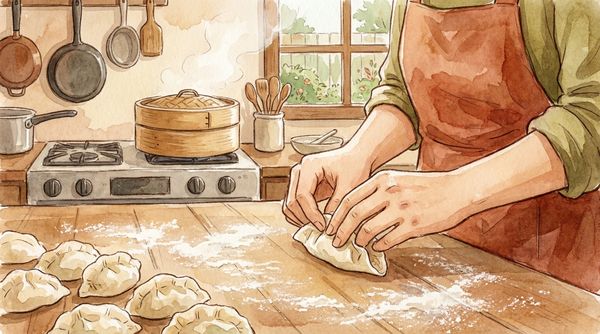
The table is covered in flour. There are small rounds of dough laid out in rows. A bowl of filling sits in the center — pork and cabbage, or shrimp and chive, or whatever combination this family has decided is theirs. And around the table, everyone is folding.
The grandmother's dumplings are perfect — each one identical, each pleat precise, sealed in a single motion that took her fifty years to make look easy. The child's dumplings are misshapen, overstuffed, leaking a little at the seams. They will be cooked and eaten with exactly the same respect. Because the point was never the shape. The point was the folding.
Jiaozi (饺子) — Chinese dumplings — are one of the oldest and most universal foods in Chinese cuisine. They've existed in some form for at least 1,800 years. They are eaten across the country, but they belong most to the North, where wheat is the staple grain and dumplings are what Sunday dinner looks like when Sunday dinner is the whole family sitting around a table making food together.
The making is the meal. You mix the dough. You roll it thin. You cut it into circles. You fill each circle with a spoonful of the mixture — never too much, or it won't seal; never too little, or what's the point. Then you fold. The fold is where the families diverge. Some do a simple half-moon, pressed shut with a fork. Some do elaborate pleats — five folds, seven folds, decorative crimps that look like tiny sculptures. The fold is identity. The fold is lineage. You fold the way your mother taught you, and she folded the way her mother taught her.
The Cultural Moment
Jiaozi are inseparable from Chinese New Year. On New Year's Eve — the most important night of the Chinese calendar — families across northern China gather to make dumplings together. The dumplings are shaped like yuanbao, the gold ingots used as currency in imperial China, and eating them symbolizes wealth and prosperity for the coming year. Sometimes a coin is hidden inside one dumpling, and whoever finds it will have especially good luck.
The act of making dumplings together — bao jiaozi (包饺子) — is itself the celebration. The meal is the making. Families who live far apart return home for this night. The kitchen fills. The table fills. The conversation flows in the way it only flows when everyone's hands are busy with the same simple, repetitive task — mix, fill, fold, repeat.
Beyond New Year, jiaozi are everyday food. In northern Chinese cities, dumpling restaurants are as common as noodle shops. Street vendors sell them steamed, boiled, or pan-fried (guotie — potstickers, with their crispy golden bottoms). Frozen dumplings are a staple of every Chinese household freezer. But the homemade ones — the ones where someone rolled the dough and someone else mixed the filling and everyone sat down to fold together — those are different. Not better, technically. But different in the way that a letter is different from a text message. The handprint is in it.
The Recipe
This is a classic pork and napa cabbage filling with a hand-rolled dough. The dough is forgiving and the filling is adaptable. Make more than you think you need — they freeze beautifully.
Makes: about 50 dumplings (plenty for a family, and enough to freeze a batch)
For the dough:
- 2 cups all-purpose flour
- 3/4 cup just-boiled water (hot water makes a softer, more pliable dough)
- Pinch of salt
Pour the hot water into the flour gradually, mixing with chopsticks or a fork until it forms a shaggy dough. When cool enough to handle, knead for 8–10 minutes until smooth and elastic. Cover with a damp towel and let rest for at least 30 minutes. The rest is important — it relaxes the gluten and makes the dough easier to roll.
For the filling:
- 1 lb ground pork (not too lean — you need some fat for juiciness)
- 2 cups napa cabbage, finely chopped and squeezed dry
- 2 scallions, finely chopped
- 1 tablespoon fresh ginger, grated
- 2 tablespoons soy sauce
- 1 tablespoon sesame oil
- 1 tablespoon Shaoxing wine (or dry sherry)
- 1/2 teaspoon white pepper
- 1/2 teaspoon salt
Mix everything together in one direction — always stir the filling in the same direction, clockwise or counterclockwise. This aligns the proteins and creates a bouncy, cohesive texture. Mix for about 2 minutes. The filling should look sticky and hold together when you press it.
Roll the dough into a long rope. Cut into small pieces (about the size of a large grape). Roll each piece into a thin circle, about 3 inches across — thinner at the edges, slightly thicker in the center.
Place a spoonful of filling in the center. Fold in half and pinch the edges to seal — either a simple press or pleated folds. Set on a floured tray. Don't let them touch or they'll stick.
To boil: Bring a large pot of water to a rolling boil. Add dumplings in batches. When they float to the surface, add 1/2 cup cold water. When they float again, add cold water once more. When they float the third time, they're done. This three-float method ensures the filling is cooked through.
Serve with a dipping sauce: soy sauce, rice vinegar, a drizzle of chili oil, sliced garlic.
The Gathering Note
There's a Chinese saying: "Hǎo chī bù guò jiǎozi" — "Nothing is more delicious than jiaozi." It's not literally true. It's emotionally true.
When you need your hands busy — when the thinking needs to stop and the doing needs to start — make dumplings. Not because dumplings are complicated. Because dumplings are repetitive in exactly the right way. Mix, fill, fold, set aside. Mix, fill, fold, set aside. The rhythm takes over. The conversation that happens during dumpling-making is always different from the conversation that happens at dinner. It's looser. Less directed. People say things while folding dumplings that they wouldn't say across a dinner table.
And at the end, you have fifty dumplings. You made them. With your hands. The flour is on the counter and the proof is in the pot and whatever was weighing on you is a little lighter now.