🍞 Irish Soda Bread — The Bread That Doesn't Wait
Ireland — from the farmhouses of the West to wherever Irish hands need flour and buttermilk and forty minutes
The Story
There is no yeast. There is no rising time. There is no kneading, no proofing, no waiting for the dough to do something biological and mysterious. Irish soda bread does not have time for that.
Buttermilk and baking soda. That's the engine. The acid in the buttermilk reacts with the baking soda and the bread rises — not slowly, not dramatically, but enough. Enough to be bread. Real bread. Bread with a thick crust that cracks when you tear it open and a soft, dense interior that crumbles in exactly the right way when you spread butter on it while it's still warm.
This bread exists because Ireland needed bread that didn't require an oven (a bastible pot over a fire worked), didn't require yeast (expensive and hard to get in rural Ireland), and didn't require time (there was work to do). It is bread born of necessity, and it became bread beloved by choice.
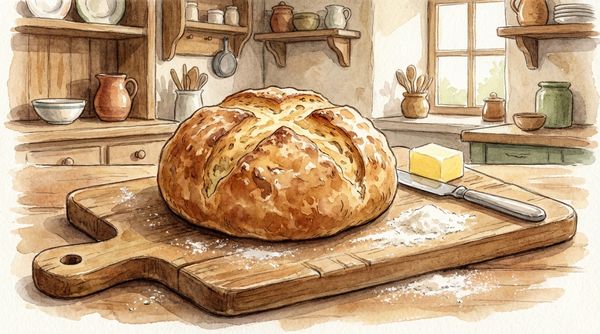
Your grandmother made it. Her grandmother made it. The recipe was never written down because it didn't need to be. Flour, buttermilk, soda, salt. A cross cut into the top — deep, to let the heat in, and because tradition said it let the devil out and the fairies in. A hot oven or a covered pot. Forty minutes. Done.
The Cultural Moment
Soda bread is an Irish invention from the 1830s and 1840s, when bicarbonate of soda became commercially available in Ireland. Before that, Irish bread was often flat — griddle breads, oatcakes, and the like. The introduction of baking soda as a leavening agent transformed Irish baking overnight. Suddenly, every farmhouse could make a risen loaf without yeast, without a professional oven, without anything but the most basic ingredients and a fire.
There are two main traditions: the round, free-form loaf baked on a sheet or in a pot, and soda farls — the dough shaped into a round, cut into four triangles (farls), and cooked on a flat griddle. The farls are more common in the North. The round loaf is more common in the South and West. Both are correct. Both are home.
The cross on top of a soda bread loaf is practical and symbolic. Practically, it helps the heat penetrate the dense dough so the center cooks evenly. Symbolically, it carries the weight of centuries of Catholic tradition — blessing the bread, warding off evil, giving thanks for what the earth provided. In some houses, the person cutting the cross would say a short prayer. In others, they'd just do it because that's how it's done and you don't ask why.
The Recipe
This is the traditional version — four ingredients, no extras. Some people add raisins, caraway seeds, or honey. Those people are making a different (and perfectly valid) bread. This is the one that has fed Ireland for two hundred years.
Makes: 1 loaf
- 4 cups (500g) all-purpose flour (or use half wholemeal flour for brown soda bread)
- 1 teaspoon baking soda (bicarbonate of soda)
- 1 teaspoon salt
- 1 3/4 cups (400ml) buttermilk (if you don't have buttermilk: mix 1 3/4 cups regular milk with 1 tablespoon lemon juice or white vinegar, let sit 10 minutes)
Preheat your oven to 425°F (220°C). Line a baking sheet with parchment paper, or use a cast-iron skillet or Dutch oven.
Mix the flour, baking soda, and salt in a large bowl. Make a well in the center and pour in the buttermilk. Using one hand (tradition says one hand — the other holds the bowl), mix quickly until the dough just comes together. It will be shaggy and sticky. Do not over-mix. Do not knead. The less you handle this dough, the better the bread. Over-working develops gluten, which makes soda bread tough instead of tender.
Turn the dough onto a lightly floured surface. Shape into a round about 2 inches thick. Place on the baking sheet. Cut a deep cross into the top — go almost to the bottom of the loaf. The four sections should be able to open slightly.
Bake for 15 minutes at 425°F, then reduce to 400°F (200°C) and bake for another 20–25 minutes. The bread is done when it sounds hollow when you tap the bottom. Let it cool on a wire rack for at least 10 minutes.
Eat it warm. With butter. With nothing else needed, though everything is welcome.
The Gathering Note
When the house is full — when the cousins have arrived and the kettle is on and someone is already telling a story that everyone has heard before but nobody stops — the soda bread appears. Not because someone planned it. Because someone looked at the kitchen and thought: we need bread. And forty minutes later, there it was.
That's the gift of soda bread. It doesn't require planning. It doesn't require skill beyond the skill of knowing when to stop mixing. It requires flour and buttermilk and a hot oven and the knowledge, passed down without being taught, that bread is how you tell a house full of people: you're welcome here. Sit down. Have some.