🫓 Injera & Wot — The Bread That Becomes the Plate
Ethiopia and Eritrea — from Addis Ababa to Asmara to every Ethiopian restaurant that became someone's second home
The Story
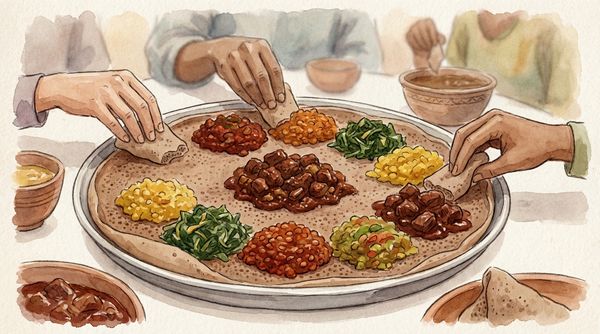
There are no utensils. There is no plate — or rather, the plate is the bread, and you eat that too.
This is how Ethiopian food works: a large round of injera — spongy, slightly sour, full of tiny holes like a soft, edible sponge — is laid out on a shared platter. On top of it, in colorful mounds, go the stews: doro wot (chicken in a deep red berbere sauce), misir wot (red lentils, spiced and stewed until they're almost a paste), gomen (collard greens, tender and garlicky), shiro (ground chickpea stew, smooth as velvet), tibs (sautéed meat with peppers and onions). More injera comes rolled on the side, for tearing and scooping.
You eat with your hands. You tear off a piece of injera, use it to pinch a bite of wot, and put the whole thing in your mouth. The bread is the fork. The bread is the plate. The bread is the table.
And then there's gursha — the act of feeding someone else by hand. You tear the injera, scoop the best bite of wot, and place it directly in someone else's mouth. It's an act of love, of respect, of welcome. When someone gives you gursha, you don't refuse. You open your mouth and receive it. The bigger the gursha, the bigger the affection.
The Cultural Moment
Ethiopia has one of the oldest food cultures in the world. The coffee ceremony alone — roasting green beans over charcoal, grinding them by hand, brewing in a jebena (clay pot), serving three rounds that each have a name and a meaning — is a ritual that predates most of what we call "coffee culture" by centuries.
Injera is made from teff, a grain indigenous to the Ethiopian highlands that is so small you can hold a hundred grains in your palm. Teff has been cultivated in Ethiopia for at least 3,000 years. The batter is fermented — mixed with water and left to sit for 2 to 3 days until it develops the sour tang that gives injera its character. Then it's poured in a thin spiral on a hot clay plate called a mitad and cooked until the surface is covered in those signature bubbles — the "eyes" of the injera.
The communal platter — eating from the same bread, with your hands, feeding each other — is not quaint. It's deliberate. In Ethiopian culture, sharing a meal from one plate is called lemat, and it signifies trust, kinship, and mutual respect. You don't eat from a separate plate if you're family. You eat together, from the same bread, because the meal is not about individual portions. It's about the circle.
The Recipe
True injera requires teff flour and 3 days of fermentation. This version uses a shortcut blend that gets you close. The wot recipe below is for the classic doro wot — chicken stew — simplified for a home kitchen but keeping the soul intact.
Serves: 6–8 (this is communal food — scale up freely)
For the Injera (simplified):
- 1 cup teff flour (dark teff for the most authentic flavor)
- 1 cup all-purpose flour
- 2 1/2 cups warm water
- 1/2 teaspoon salt
- 1/2 teaspoon baking powder (the shortcut for fermentation tang)
- 1 tablespoon apple cider vinegar (to mimic the fermented sourness)
Mix the flours and warm water in a bowl until smooth. For the quick version: add the salt, baking powder, and vinegar, let rest 30 minutes. For a better version: skip the baking powder and vinegar, cover the bowl, and let it sit at room temperature for 1–3 days, stirring once a day, until it smells slightly sour and bubbly. Then add the salt.
Heat a large non-stick skillet over medium heat. Pour the batter in a thin spiral from the outside in — like making a crepe, but don't spread it. Cook until the surface is dry and covered with tiny holes, about 2 minutes. Do not flip. The bottom should be smooth; the top should look like a sponge. Remove and lay on a clean towel. Repeat.
For the Doro Wot (chicken stew):
- 6 chicken drumsticks or thighs
- 4 large onions, finely diced (yes, four — the onions ARE the sauce)
- 3 tablespoons berbere spice blend
- 2 tablespoons niter kibbeh (Ethiopian spiced butter) or regular butter
- 3 cloves garlic, minced
- 1 inch fresh ginger, grated
- 2 tablespoons tomato paste
- 1 cup water or chicken stock
- 4 hard-boiled eggs, peeled
- Juice of 1 lemon
- Salt to taste
In a large dry pot, cook the diced onions over medium-low heat, stirring frequently, for 15–20 minutes. No oil. No butter. The onions will release their moisture and slowly caramelize into a deep golden base. This is the foundation. Don't skip this step.
Add the niter kibbeh and stir. Add the berbere spice, garlic, ginger, and tomato paste. Cook for 5 minutes, stirring constantly — the spices need to bloom in the fat. Add the water or stock. Nestle in the chicken pieces. Cover and simmer for 45 minutes to an hour, until the chicken is tender and the sauce is thick and deeply red.
Score the hard-boiled eggs with a knife (small cuts all over the surface — this lets the sauce penetrate). Add them to the pot in the last 15 minutes. Squeeze the lemon juice in at the end. Taste for salt.
Serve on a large platter lined with injera. Spoon the wot in mounds on top. Roll extra injera on the side. Eat with your hands.
The Gathering Note
In Amharic, the word for "meal" and the word for "invitation" live close together. Because a meal, in Ethiopia, is always an invitation — to sit, to share, to be fed by someone else's hands.
When the house is full of people and the injera is laid out and the wot is steaming and someone reaches across the platter to give you gursha — that oversized, messy, affectionate bite of food placed directly in your mouth — you are not just eating. You are being claimed. You are one of mine. Let me feed you.
The platter doesn't run out. The injera keeps coming. And the circle around the table keeps making room.