🍳 Full English — The Fry-Up That Forgives Everything
Britain — and every greasy spoon, B&B, and kitchen where the morning started slow and the kettle went on first
The Story
You had a night.
Maybe it was a good night — the kind that ended at 2 AM with someone saying "one more" and meaning it. Maybe it was a bad night — the kind where you didn't sleep, or slept wrong, or lay in the dark thinking about something you can't fix. Maybe it was just a night, and now it's morning, and morning in Britain has always had a particular answer to the question of what to do next.
You make a fry-up.
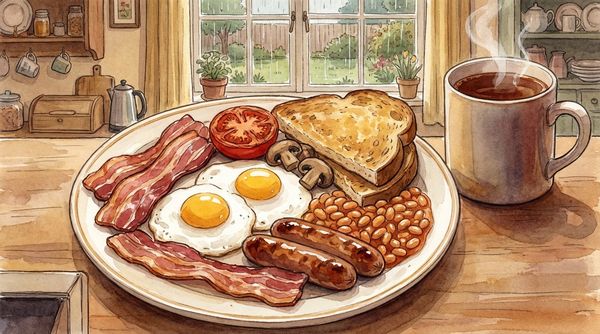
The Full English is not health food. It has never pretended to be health food. It is a plate of bacon, eggs, sausages, beans, toast, grilled tomato, mushrooms, and — depending on which part of Britain your grandmother was from — black pudding, hash browns, fried bread, or all of the above. It is a plate that says: whatever happened, we're starting again. The day begins here. Eat.
The beauty of the Full English is its democracy. Every item on the plate is common. Cheap. Nothing fancy. Eggs from the shop. Sausages from the butcher or, honestly, from a packet — nobody's judging at 9 AM on a Sunday. Tinned beans. The tomato that's been sitting on the counter since Thursday and needed using up. The mushrooms you bought with good intentions for a pasta that never happened. The Full English is the meal that turns "we have nothing in" into a feast, because the magic isn't in any single ingredient. It's in the assembly.
And the assembly is an art form that nobody will admit is an art form.
The challenge of the fry-up is timing. Everything cooks at a different speed and everything must arrive on the plate at the same time, hot. The bacon goes first because it takes longest to get properly crisp. Then the sausages, because they need browning on all sides and patience in the middle — a sausage that's burnt outside and pink inside is a moral failure. The mushrooms and tomato go in next, sharing a pan if necessary. The beans go on low heat in a saucepan and are largely ignored until the last minute, which is fine because beans are forgiving. The toast goes in the toaster at the absolute last second. And the eggs — the eggs are timed with the precision of someone defusing a bomb, because a perfect fried egg has a runny yolk and crispy edges and a window of about forty-five seconds between "perfect" and "ruined."
Every person in Britain who makes a fry-up believes they have mastered this timing. Most of them are slightly wrong about one element. Nobody mentions it. You eat what's on the plate. You say "that's lovely" because someone made you breakfast and that's what you say.
The mug of tea is not optional. It arrives before the food, during the food, and after the food. It is the scaffolding that holds the entire meal together. Without the tea, it's just a plate. With the tea, it's a Sunday.
The Cultural Moment
The Full English has been a constant in British life since the Victorian era, when the country house breakfast was a long, elaborate affair designed to fuel a day of hunting, walking, or pretending to read the newspaper while actually napping in a leather chair. The working-class version adapted: same components, smaller kitchen, faster pace, eaten before a shift or after one.
By the mid-twentieth century, the fry-up had become Britain's universal comfort meal. The "greasy spoon" — the no-frills café with Formica tables, ketchup in squeeze bottles, and a cook who can produce forty plates an hour without breaking a sweat — became an institution. Lorry drivers, builders, nurses finishing night shifts, students who couldn't afford dinner but could afford breakfast — the greasy spoon was the great leveller. Everyone got the same plate. Everyone sat in the same plastic chairs.
The fry-up also adapted across Britain's borders while keeping its soul. In Scotland, you might get a tattie scone and Lorne sausage — square, flat, and unapologetically different from the English banger. In Ireland, the "Full Irish" adds white pudding and soda bread. In Wales, laverbread (made from seaweed) appears alongside the bacon. Each variation is fiercely defended by its region and gently mocked by every other region. This is how the British Isles express love.
The B&B fry-up deserves special mention. If you've ever stayed at a bed and breakfast anywhere in Britain — a converted house with floral wallpaper and a dining room that seats eight — you've had the experience of a landlady appearing at your table at 8 AM and asking, "Full English?" as if there were another option. There is not another option. She brings you a plate so full that the beans are touching the eggs and the toast is balanced on the edge like a structural afterthought. You eat all of it because she's watching from the kitchen doorway and you can feel her approval as a physical force.
The fry-up has survived every food trend, every health campaign, every newspaper article warning about cholesterol. It survives because it was never about nutrition. It was about the morning. It was about someone standing at the stove with four pans going and the radio on, making sure that whatever happened last night, this morning has a plate waiting.
The Recipe
This is a proper Full English. Not a reduced version, not a "healthy swap" version. The full thing. You can leave items off if you want — but then it's not full, is it?
Serves: 2 (a fry-up for one is fine but a fry-up for two is a shared act of recovery)
What you need: - 4-6 rashers of back bacon (streaky if you prefer it crispier — this is a personal decision that reveals character) - 4 pork sausages (good ones — this is not the place to economise) - 4 eggs - 1 tin of baked beans (Heinz is the standard; other brands exist but are viewed with suspicion) - 2-4 slices of bread for toast (thick-cut white, or brown if you're making a point) - 2 tomatoes, halved - A handful of mushrooms, sliced thickly - Butter — for everything - Salt and pepper - Vegetable oil or a knob of dripping for the pan - Brown sauce or ketchup (this is a choice that divides families; both are correct)
Optional but encouraged: - Black pudding, sliced into rounds (if you've never tried it, this is the moment — it's better than it sounds) - Hash browns (frozen ones from the oven are absolutely acceptable) - Fried bread (a slice of white bread fried in the bacon fat until golden and dangerous)
What you do:
Put the kettle on. Make tea. This is step one. Everything else follows.
If you're having hash browns, put them in the oven first — 200°C, about 20 minutes. They'll be ready when everything else is.
Get your largest frying pan. Put it on medium heat with a little oil. Lay the sausages in first. They need 12-15 minutes, turned regularly, until they're golden-brown all over and cooked through. Don't prick them — that lets the juices out and starts arguments.
After the sausages have had a 5-minute head start, add the bacon. Back bacon wants 3-4 minutes per side. Streaky wants less. Watch it — the line between crispy and cremated is thinner than you think.
Push the bacon and sausages to one side (or move them to a warm plate in the oven). In the same pan — the fat from the bacon is now your cooking medium, this is the entire point — add the tomato halves cut-side down. Add the mushrooms. Season with salt and pepper. The tomatoes need about 4 minutes to soften and caramelise. The mushrooms need about the same, stirred once or twice.
Put the beans in a small saucepan on low heat. Stir occasionally. They need almost no attention and they will reward your neglect by being perfectly warm when everything else is ready.
If you're making fried bread, now is the time. A slice of white bread, pressed into the bacon fat in the pan, fried on each side until golden and slightly obscene. Remove and drain on kitchen paper if you're that sort of person. Don't drain if you're not.
If you're doing black pudding, it needs only 2 minutes per side in the pan. It should be crisp outside and soft inside.
Put the toast on now.
And finally — the eggs. Clear a space in the pan or use a separate one. A little more butter or oil. Crack the eggs in gently. Fry on medium heat until the whites are set and the edges are lacy, but the yolk is still soft. About 3 minutes. Spoon hot fat over the top of the whites if they're being stubborn. Do not flip the eggs. A Full English egg is sunny-side up. This is non-negotiable in most households and negotiable in yours, but you should know the tradition you're breaking.
Assemble. Everything goes on one plate. The eggs go in the centre because they're fragile. The toast goes on the edge. The beans go wherever they fit — they will encroach on everything and this is their right. Butter the toast while it's still hot.
Sit down. Eat slowly. Drink the tea. Read the paper or look out the window or say nothing at all. The morning has officially begun.
The Gathering Note
The Full English is Sunday morning food. Not because Sunday is special, but because Sunday is the one morning where time moves slowly enough for four pans to be on the stove at once. It's the meal that happens when nobody has anywhere to be, or when everyone has somewhere to be but nobody wants to acknowledge it yet.
In British households, the person who makes the fry-up is performing a quiet act of service. It takes 30-40 minutes of standing, timing, and managing chaos. It is not glamorous work. But when the plate arrives — hot, full, everything in its right place — the person receiving it doesn't need to say much. "That's lovely" will do. Because someone stood at the stove and made the morning make sense, and that's what the fry-up has always been for.
Whatever happened last night, there's breakfast.