🍲 Fufu & Light Soup — The Swallow That Holds You
Ghana — and every kitchen across West Africa where pounding is prayer and the soup is the answer
The Story
The sound comes first.
Before you smell the soup, before you see the bowl, you hear the pounding. A heavy wooden pestle in a carved mortar — waduro — and the rhythm is unmistakable: a deep thud, a pause, a turn of the dough by hand, another thud. It's the heartbeat of a Ghanaian kitchen. In some compounds, you can hear it from the street. In some neighbourhoods, you can hear three or four mortars going at once, each family's rhythm slightly different, a percussion section that nobody rehearsed and nobody needs to.
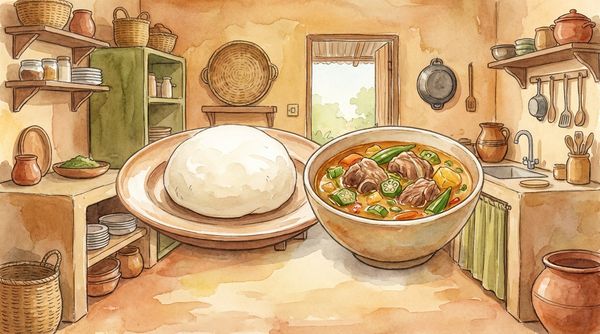
Fufu is what emerges from that pounding. Boiled cassava and plantain (or yam, depending on the region and the household), pounded together until the two become one — a smooth, stretchy, almost impossibly soft mass that you pull off in pieces and swallow. Not chew. Swallow. This is the part that surprises anyone who didn't grow up with it. Fufu is not chewed. You tear off a small piece with your right hand, press a dent into it with your thumb to make a little cup, dip it into the soup, and swallow it whole. The texture is the experience — soft, yielding, warm — and the soup that clings to it is where all the flavour lives.
Light soup — nkrakra — is the companion that makes fufu sing. It is a tomato-based broth, thin and clear compared to the heavier groundnut or palm nut soups, but vivid with flavour: tomatoes, onions, ginger, chilli, and whatever protein the household has — chicken, goat, fish, or all three. The "light" in the name refers to the texture, not the taste. Light soup is deeply flavoured, peppery, and warming in a way that reaches your chest before it reaches your stomach.
When someone in Ghana is sick, fufu and light soup is what appears. When someone has lost a loved one, fufu and light soup is what the women of the family begin preparing before the first visitors arrive. When a new mother is recovering, fufu and light soup is what her mother or mother-in-law makes, because the warmth of the broth and the gentleness of the fufu are exactly what a body in recovery needs. The pepper opens the sinuses. The ginger settles the stomach. The protein rebuilds. The swallowing — the act of receiving food without even needing to chew — is as close to being fed as an adult can get.
This is not accidental. In Ghanaian culture, fufu and light soup is care made edible. It is what you make when someone needs to be held and your hands are the wrong shape for holding, so you hold them this way instead: with a mortar and pestle and a pot of broth that's been on the stove since morning.
The Cultural Moment
Fufu is the staple food of the Akan people of Ghana and has spread across West Africa — into Nigeria (where it's made from yam and often called iyan), Cameroon, Côte d'Ivoire, Sierra Leone, and throughout the diaspora. The word itself is Akan, and the dish is so central to Ghanaian identity that there's a saying: "If you haven't eaten fufu, you haven't eaten."
The pounding of fufu is traditionally a two-person job. One person wields the pestle — a heavy wooden pole, three to four feet long — while the other sits beside the mortar and turns the dough between each stroke. The turner's hand goes into the mortar between blows, a movement that requires absolute trust in the pounder's rhythm. Miss a beat, and a hand gets hit. In decades of tradition, this almost never happens, because the rhythm is learned from childhood. Children start turning fufu young, learning the timing by feel, and by the time they're old enough to take the pestle, the rhythm is in their body.
The pounding itself is a form of processing that no machine can truly replicate. Modern fufu powder exists — you add water and stir — and instant fufu has its place in busy weeknight kitchens and diaspora apartments where the sound of pounding would bring complaints from the neighbours. But pounded fufu has a different texture: smoother, stretchier, more alive. The pounding breaks down the starch at a molecular level in a way that processing doesn't. Ghanaians can tell the difference with their eyes closed.
Fufu appears at every significant gathering in Ghanaian culture. Funerals in Ghana are elaborate, multi-day community events, and the feeding of mourners is a sacred responsibility. Fufu and soup — light soup, groundnut soup, palm nut soup — is what's served, in large quantities, because when a community gathers in grief, the food must be substantial enough to hold them. Not delicate. Not portioned. Substantial. The kind of food that fills your belly and tells your body: you are being cared for. Sit. Eat. We are here.
In the Ghanaian diaspora — in London's Peckham, in the Bronx, in suburban Maryland — fufu restaurants and chop bars serve as community centres. The menus are simple: fufu with your choice of soup, or banku (fermented corn dough) with your choice of stew. The tables are communal. The bowls are large. The act of eating fufu in a foreign country, surrounded by people who know the rhythm, is an act of belonging that no amount of video calling can replace.
The Recipe
This is fufu from scratch — the pounded version, with cassava and plantain. If you don't have a mortar and pestle, you can use a stand mixer with a dough hook or even a heavy pot and a wooden spoon with significant arm strength. The light soup is made alongside it. Together, they are a complete meal.
Serves: 4-6
For the fufu: - 2 lbs cassava, peeled and cut into chunks (fresh cassava from an African or Caribbean grocery store — frozen works too) - 3 ripe plantains, peeled and cut into chunks (ripe means yellow with black spots — not green, not fully black) - Water for boiling
For the light soup (nkrakra): - 1 whole chicken, cut into pieces (or 2 lbs chicken pieces — thighs and drumsticks work best) - 6 large Roma tomatoes, roughly chopped - 2 medium onions — one roughly chopped for the blend, one sliced for the pot - 1-inch piece of fresh ginger, peeled - 3-4 fresh chilli peppers (scotch bonnet or habanero — use 2 for moderate heat, 4 for Ghanaian-level heat) - 3 cloves garlic - 2 tablespoons tomato paste - Salt to taste - 1 teaspoon ground white pepper (optional but traditional) - Fresh basil leaves — the large-leaf African variety if you can find it (akoko mesa), or regular basil - 4-6 cups water
What you do:
Start the soup first — it takes longer and the fufu should be fresh.
Season the chicken pieces generously with salt. Set aside.
Blend the tomatoes, chopped onion, ginger, chilli peppers, and garlic into a smooth paste. Don't add water — the tomatoes have enough liquid.
In a large pot, bring 4-6 cups of water to a boil. Add the chicken pieces and the sliced onion. Boil for 20 minutes until the chicken is cooked through and the broth has taken on flavour.
Remove the chicken pieces and set them aside. Into the broth, pour the blended tomato-pepper paste and the tomato paste. Stir well. Bring to a boil, then reduce to a steady simmer.
Let the soup cook for 25-30 minutes, stirring occasionally. It will reduce and the raw tomato taste will cook out. The colour will shift from bright red to a deeper, more complex orange-red. The oil from the tomatoes will begin to float on the surface — this is how you know it's ready.
Return the chicken pieces to the soup. Add salt and white pepper. Taste — the soup should be savoury, peppery, and warming. If it needs more heat, press on the chillies gently with a spoon. Tear the basil leaves and stir them in during the last 5 minutes. Keep the soup at a low simmer while you make the fufu.
Make the fufu.
Boil the cassava chunks in salted water for 20-25 minutes until very soft — a fork should pass through with no resistance. In a separate pot (or after the cassava is done), boil the plantain chunks for 15 minutes until soft.
Drain both. While they're still hot, combine them in a mortar (or a large, deep bowl if you're using the improvised method).
Pound. This is the work. The pestle rises and falls, and between each stroke, the dough is turned by hand (or with a wet wooden spoon). The goal is a completely smooth, stretchy, lump-free mass. This takes 10-15 minutes of sustained effort. The fufu is done when it pulls away from the mortar cleanly, stretches without breaking, and has a surface that's smooth and slightly shiny.
If using a stand mixer: combine the hot cassava and plantain, add a tablespoon or two of warm water, and knead with the dough hook on medium speed for 8-10 minutes. It won't be identical to pounded, but it will be close.
Wet your hands. Pull off a portion of fufu (about the size of a tennis ball per person) and shape it into a smooth mound. Place it in a deep bowl.
Ladle the light soup over and around the fufu. Place one or two pieces of chicken in the bowl. The fufu sits in the soup like an island — the broth surrounds it, and you eat from the outside in.
How to eat:
With your right hand. Tear off a small piece of fufu. Press your thumb into it to make a shallow cup. Dip it into the soup, capturing some broth. Place it on your tongue and swallow — don't chew. The fufu slides down gently. The soup follows. The pepper warms your chest. This is the rhythm: tear, dip, swallow. Tear, dip, swallow. Eat the chicken with your hands when you reach it.
There is no elegant way to eat fufu. There is only the right way — with your hands, unhurried, in the company of people who don't need you to explain anything.
The Gathering Note
Fufu is not fast food. It is not convenience food. It is the food that takes an hour of pounding and a morning of simmering and the kind of effort that only makes sense when the effort itself is the point. You don't make fufu because it's easy. You make it because someone needs to be fed in a way that goes beyond calories.
In Ghanaian homes, the sound of fufu being pounded is an announcement: something is happening today. Someone is being cared for. The community is gathering. The soup is on.
When you place a bowl of fufu and light soup in front of someone who is grieving, or recovering, or simply exhausted by the world, you are not just feeding them. You are saying: I stood at the mortar. I pounded this. I made the soup. I did this with my hands because my hands needed something to do for you. The bowl holds more than food. The swallow holds more than starch. The soup holds more than pepper.
It holds you. That's what it was always for.