🥟 Empanadas — The Hand Pie That Fills Every Gathering
Argentina, and across Latin America — and every kitchen, street corner, and family gathering where dough meets filling and everyone reaches for one more
The Story
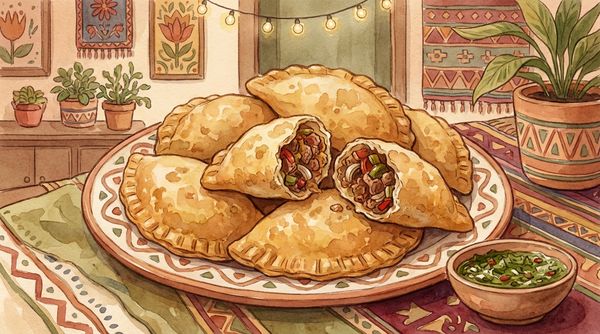
The first thing you should know about empanadas is that no one eats just one. The second thing is that everyone's mother makes them differently, and everyone's mother is correct. An empanada is a hand pie — dough folded around filling, sealed, and either baked or fried. That description is technically accurate and completely inadequate, like describing a cathedral as "a building with some windows." An empanada is a pocket of warmth that fits in your palm. It is the food that appears on every Argentine table when the house is full, that lines the counters at every Latin American party, that gets passed around on trays at every gathering where someone cared enough to spend the morning filling and folding. In Argentina, empanadas are identity. Not national identity in the flag-waving sense — regional identity. The kind that sparks arguments at family dinners that have been running for decades and show no sign of resolution. Empanadas tucumanas — from the province of Tucumán in the northwest — are the ones most Argentines will cite as the standard. Hand-cut beef, cumin, hard-boiled egg, a single green olive, and paprika. Baked, never fried. The repulgue — the crimped seal along the edge — is a point of pride. Every province has its own pattern, and a knowledgeable Argentine can look at the crimping and tell you where the empanada was made the way a sommelier reads a label. Empanadas salteñas — from Salta — are juicier, sweeter, with a touch of sugar in the filling and potato in the dough that makes them softer. Empanadas mendocinas — from Mendoza, the wine country — are larger, often fried, the dough thicker. In the coastal provinces, the filling might be tuna or shrimp. In Patagonia, lamb. In Buenos Aires, frankly, everything — because Buenos Aires is a city that borrowed from everywhere and added mozzarella. Every version follows the same ritual. Someone makes the dough — or buys tapas de empanadas from the shop, which is not cheating, it is surviving. Someone makes the filling. Someone assembles. The assembly is the social part: dough discs laid out on the counter, a bowl of filling in the centre, and a line of people spooning, folding, crimping. Children are given the task of pressing the edges with a fork. Teenagers are given the task of carrying trays to the oven. Grandmothers supervise from a chair and correct everyone's technique without standing up. The oven batch takes 20 minutes. The first empanada out of the oven is always too hot to eat. Everyone eats it anyway. Someone burns the roof of their mouth and says nothing because the taste is worth it — the crust golden and flaky, the filling steaming, the olive an unexpected burst of salt in the middle. Then the tray is empty and someone says, "How many did we make?" and the answer is never enough.
The Cultural Moment
Empanadas arrived in the Americas with the Spanish colonisers, who brought the tradition from the Iberian Peninsula — which had inherited it, in turn, from the Moors, who brought filled pastries from North Africa and the Middle East. The word comes from empanar — to wrap in bread. The concept is universal: every culture on earth has some version of dough wrapped around filling. But Latin America made the empanada its own. In Argentina, the empanada became inseparable from the asado — the sacred barbecue ritual — where empanadas are served first, while the meat is still on the grill, as a way of saying: the gathering has begun, the food is here, relax, the asador has everything under control. Empanadas are the overture. The asado is the symphony. But empanadas are also workday food. In every Argentine city, casas de empanadas — empanada shops — line the streets. Office workers buy them by the dozen for lunch. Students buy them by the half-dozen for dinner. Taxi drivers buy two and eat them at red lights. The empanada is the food that fits into the spaces of a busy life — portable, complete, one-handed — without ever feeling like fast food. It feels like someone made it. Across Latin America, the empanada takes on local character while keeping its soul. In Colombia, empanadas are fried, made with corn dough, filled with potato and meat, and sold on every street corner by vendors who have been standing at the same spot since before anyone can remember. In Chile, the empanada de pino — filled with beef, onions, olives, raisins, and a quarter of a hard-boiled egg — is the centrepiece of Fiestas Patrias, the national independence celebration in September. In Venezuela, the empanada is made with corn flour and deep-fried until the crust shatters. In Puerto Rico, empanadillas are smaller, crisper, and appear at every party in quantities that suggest the host has no idea how many people are coming and doesn't care. Every version says the same thing: there are people in the house, and the food is ready.
The Recipe
This is the Argentine tucumana-style empanada — baked, beef-filled, with the classic olive-and-egg combination. This is the empanada that shows up when the family gathers. Adapt the filling to your province, your country, your kitchen — the hand pie is universal. Makes: about 24 empanadas (this is a gathering quantity — scale down only if you must) For the dough (or buy pre-made tapas de empanadas — no judgment, everyone does): - 4 cups all-purpose flour - 1 teaspoon salt - 1/2 cup lard or butter (lard is traditional and makes a flakier crust; butter is richer — both work) - 1 egg - 3/4 cup warm water - 1 tablespoon white vinegar (this helps the dough relax) For the filling (relleno): - 1.5 lbs beef — use a cut with some fat. Flank steak or skirt steak, cut by hand into very small cubes (not ground — the hand-cut texture is part of the tradition) - 2 large onions, finely diced - 3 tablespoons beef fat, lard, or vegetable oil - 2 tablespoons sweet paprika (pimentón dulce) - 1 tablespoon ground cumin - 1 teaspoon dried oregano - 1/2 teaspoon chilli flakes (or more, depending on who's eating) - Salt and black pepper to taste - 12 green olives (pitted — one per empanada if you're making 24, half an olive per if you're stretching) - 3 hard-boiled eggs, each cut into 8 pieces - 2 tablespoons chopped scallion (green onion) For the glaze: - 1 egg beaten with 1 tablespoon water What you do: Make the dough. Combine flour and salt. Cut in the lard or butter until the mixture looks like coarse sand. Add the egg, warm water, and vinegar. Knead gently until smooth — 3-4 minutes, no more. The dough should be soft and pliable, not elastic. Wrap in plastic and refrigerate for at least 30 minutes. Make the filling. Heat the fat in a large pan over medium heat. Add the onions and cook until soft and translucent — about 8 minutes. Add the beef cubes. Cook, stirring, until the meat is browned on the outside but still a little pink inside — the filling will finish cooking in the oven. Add the paprika, cumin, oregano, chilli flakes, salt, and pepper. Stir until the spices coat everything and the kitchen smells like Argentina. Remove from heat. Stir in the scallions. Spread the filling on a plate or sheet pan and refrigerate until cool — at least 30 minutes. Hot filling melts the dough. Cold filling makes crisp empanadas. This is non-negotiable. Assemble. Roll out the dough on a floured surface to about 1/8 inch thick. Cut circles about 5-6 inches across — a small plate or a bowl works as a guide. Gather and re-roll scraps. Place a generous spoonful of filling on each circle — not in the centre, slightly off-centre. Add a piece of hard-boiled egg and an olive (or half). Fold the dough over the filling into a half-moon. Press the edges together with your fingers, then crimp: fold the edge over itself in small pleats all the way around, pressing each pleat firmly. This is the repulgue. It takes practice. The first few will look rough. By the tenth, you'll have a rhythm. Place the assembled empanadas on a lined baking sheet. Brush with the egg wash — this is what gives them their golden colour. Bake at 200°C (400°F) for 18-22 minutes, until golden brown and the kitchen smells like the kind of afternoon where nothing matters except the next empanada. Let them cool for exactly long enough that you won't burn yourself. Then eat one immediately. Then reach for another.
The Gathering Note
Empanadas are the food that means the house is about to be full, or already is. They are never made for one person. The recipe doesn't scale down gracefully — it wants to be doubled. Twenty-four becomes forty-eight because someone called to say they're bringing their cousin. The cousin brings a friend. The friend stays for the asado. In Argentine homes, the empanada tray is the first thing that goes out and the first thing that comes back empty. It is the food that doesn't require plates, or silverware, or sitting down. You eat empanadas standing in the kitchen, or on the patio, or walking past the counter. You eat them with one hand while holding a glass of Malbec in the other. You eat them telling a story, and mid-sentence you pause, bite, chew, and pick up exactly where you left off. The tray will be empty too soon. It is always empty too soon. Next time, you'll make more. You always say this. You always do.