🍛 Dal Chawal — The First Meal and the Last Resort
India — from every state, every language, every kitchen where someone needs feeding and the answer is always the same
The Story
In India, when you don't know what to eat, you eat dal chawal. When you're sick, you eat dal chawal. When you're heartbroken, or exhausted, or celebrating, or grieving, or just alive on a Tuesday — dal chawal.
It is lentils and rice. That's it. That's the whole thing.
Except it's not the whole thing, because the way those lentils are cooked — with turmeric and cumin and garlic and sometimes tomato and sometimes not, tempered with a tadka of hot ghee and mustard seeds and dried chili that sizzle and pop when they hit the dal — transforms two of the humblest ingredients on earth into something that feels like being held.
Every state in India has its dal. In Punjab, it's dal makhani — black lentils simmered overnight with butter and cream until they're dark and velvety. In Gujarat, it's dal dhokli — a thinner dal with wheat dumplings floating in it. In Bengal, it's moong dal with the delicate sweetness that Bengali cooking brings to everything. In South India, it's sambar — a tangy, vegetable-loaded lentil stew seasoned with tamarind and a completely different spice logic.
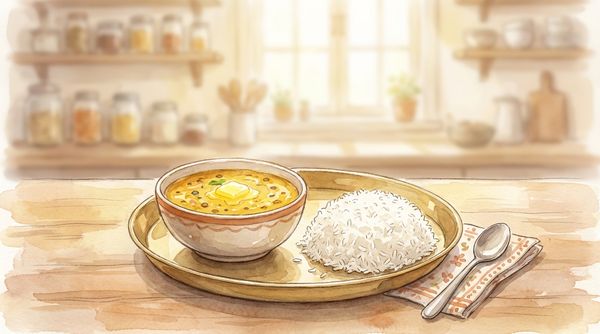
But when people say "dal chawal" with that specific tone — the one that means home, safety, enough — they usually mean the simple version. Yellow or red lentils. Turmeric. Salt. A tadka. Rice. That's the one your mother made when you were sick. That's the one you make for yourself when nobody is watching and you just need to eat something that remembers you.
The Cultural Moment
Dal chawal is the common denominator of Indian food. In a country of 1.4 billion people speaking 22 official languages with cuisines that vary wildly from state to state — a country where a meal in Kerala looks nothing like a meal in Rajasthan — dal chawal is the thread that runs through all of it. Rich and poor eat it. North and South eat it. Vegetarian and non-vegetarian households both center it. It is arguably the single most-eaten meal in India, and therefore one of the most-eaten meals on earth.
The combination is also nutritionally complete in a way that seems almost designed. Lentils provide protein and iron. Rice provides carbohydrates and energy. Together, they form a complete protein — the amino acids that one lacks, the other provides. This isn't an accident. This is thousands of years of culinary wisdom encoded in a bowl.
The tadka (also called chaunk, baghaar, or tempering) is the moment of transformation. Ghee or oil is heated until it shimmers. Spices are added — mustard seeds, cumin seeds, dried red chili, curry leaves, asafoetida — and they crackle and bloom in seconds, releasing flavors that raw spices can't. This fragrant, sizzling mixture is poured directly into the cooked dal. It hisses. It steams. The whole pot changes character in an instant.
The Recipe
This is the simplest, most comforting version — the one that feels like a hug. Yellow lentils, basic spices, a proper tadka. Everything else is optional.
Serves: 3–4
- 1 cup yellow lentils (toor dal or moong dal — both work, moong cooks faster)
- 3 cups water
- 1/2 teaspoon turmeric
- Salt to taste
- Cooked rice for serving
For the tadka:
- 2 tablespoons ghee (or oil, but ghee is the soul of this dish)
- 1 teaspoon cumin seeds
- 1 teaspoon mustard seeds
- 2 dried red chilies, broken in half
- A pinch of asafoetida (hing) — optional but traditional
- 4–5 curry leaves (if you can find them)
- 3 cloves garlic, thinly sliced
- 1 small onion, finely chopped (optional)
- 1 small tomato, chopped (optional)
Wash the lentils until the water runs clear. Put them in a pot with 3 cups of water and the turmeric. Bring to a boil, then reduce to a simmer. Cook until the lentils are completely soft and falling apart — 25 to 35 minutes for toor dal, 15 to 20 for moong dal. Skim any foam that rises. Add salt.
For the tadka: Heat the ghee in a small pan until it shimmers. Add the cumin seeds and mustard seeds — they'll pop and crackle immediately. Add the dried chilies, asafoetida, and curry leaves. Then the garlic — let it turn golden, not brown. Then the onion if using — cook until soft. Then the tomato if using — cook until it breaks down.
Pour the entire tadka — ghee, spices, and all — directly into the pot of dal. It will sizzle and steam. Stir it in. The dal transforms.
Serve over hot rice. A squeeze of lemon on top. A spoonful of ghee if you want richness. That's it.
The Gathering Note
In Hindi, there's a phrase: "Ghar ka khana" — home food. It doesn't mean restaurant food made at home. It means the food that only exists at home. The food that has no recipe because it was never written down. The food that tastes like the specific kitchen it came from and no other kitchen on earth.
Dal chawal is the ultimate ghar ka khana. When someone needs to be held and you don't know what to do — when the grief is too big or the sickness is too stubborn or the sadness doesn't have a name — you make dal chawal. Not because it fixes anything. Because it says: I am here. I made you the thing that means home. Eat.