🍗 Chicken Adobo — The Dish That Waits
The Philippines — from Manila to Mindanao to every Filipino kitchen in every country on earth
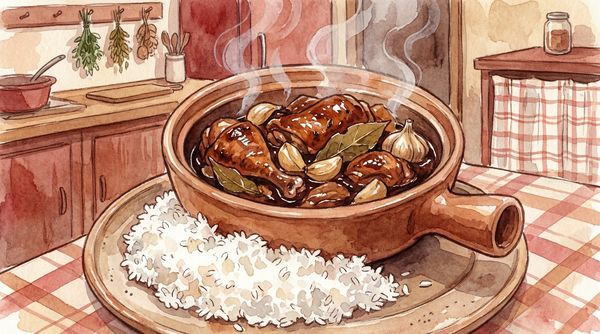
The Story
Adobo waits for you.
It waits on the stove in a covered pot, the vinegar and soy sauce and garlic having done their slow, patient work while you were away. It waits the way a good friend waits — without complaint, without keeping score, getting better the longer it sits.
In the Philippines, adobo is not a recipe. It is a principle. The word comes from the Spanish adobar — to marinate, to season — but the technique existed in the islands long before Spain arrived. Filipino cooks were braising meat in vinegar and salt for preservation and flavor centuries before colonizers named it. The Spanish saw something familiar and gave it a Spanish word. The dish didn't change. It just got a new name from people who didn't invent it.
Every Filipino family has their adobo. Every version is correct. Some use soy sauce (a later addition, from Chinese trade influence). Some don't — the older style is adobong puti, white adobo, just vinegar and garlic and salt. Some add coconut milk. Some add pineapple. Some use pork. Some use chicken. Some use both. The variations are infinite and the arguments are gentle, because everyone knows the truth: the best adobo is the one your mother made.
When someone comes home — from overseas work, from the military, from school, from wherever the Filipino diaspora has scattered its children — the pot is already on the stove. The garlic has already been crushed. The vinegar is already doing its work. Because adobo is the dish that says: I've been waiting for you. I was ready before you arrived.
The Cultural Moment
The Philippines is one of the largest labor-export countries in the world. Millions of Filipinos — called OFWs, Overseas Filipino Workers — work abroad to send money home to their families. They work in Saudi Arabia, Hong Kong, Singapore, the United States, Canada, Italy, the Gulf States, on cruise ships, in hospitals, in homes. They leave so their families can eat, go to school, have a future.
When they come home — sometimes once a year, sometimes less — the homecoming meal is sacred. And adobo is almost always part of it. Not because it's fancy. Because it's theirs. It's the taste that means the kitchen is familiar, the hands that made it are the right hands, and for a little while, the distance is erased.
The concept of bayanihan — communal unity, the spirit of helping each other — runs deep in Filipino culture. Adobo embodies this: a dish that stretches, that feeds more than expected, that improves with time. You can make it on Monday and eat it on Thursday. You can double the recipe when someone shows up unannounced. The pot adjusts. It always has room.
The Recipe
This is a classic chicken adobo — soy sauce and vinegar style. Don't stir it too much while it simmers. Let the vinegar do its work.
Serves: 4–6
- 2 lbs chicken (thighs and drumsticks, bone-in, skin-on — the bones and skin give body to the sauce)
- 1/2 cup soy sauce
- 1/2 cup white cane vinegar (or white vinegar — Filipino cane vinegar has a specific mildness, but any white vinegar works)
- 1 whole head of garlic — peeled and crushed (yes, a whole head — this is not a typo)
- 1 tablespoon whole black peppercorns
- 3–4 dried bay leaves
- 1 tablespoon vegetable oil
- Optional: 1 tablespoon brown sugar (some families add a touch of sweetness)
Combine the chicken, soy sauce, vinegar, garlic, peppercorns, and bay leaves in a pot. Let it marinate for at least 30 minutes. An hour is better. Overnight is best.
Bring the pot to a boil over medium-high heat. Then reduce to a gentle simmer. Cover and cook for 30–35 minutes, turning the chicken once halfway through.
Important: Do not stir the pot in the first 10 minutes of cooking. The vinegar needs to come to a full boil before you disturb it. If you stir too early, the vinegar stays sharp. If you let it boil first, it mellows and deepens. This is not superstition. This is chemistry.
Remove the chicken from the sauce. In a separate pan, heat the oil and sear the chicken skin-side down until the skin is golden and slightly crispy — 3 to 4 minutes. This step is optional but it's the difference between good and extraordinary.
Meanwhile, turn up the heat on the sauce and reduce it by about a third — it should thicken slightly and become glossy. Return the chicken to the sauce.
Serve over white rice. Always white rice. The sauce will pool into the rice and that is the entire point.
The Gathering Note
There's a Filipino word — gigil — that describes the overwhelming urge to squeeze something because it's so cute or so loved that your body can't contain the feeling. There is no English equivalent.
Adobo is gigil in a pot. It's the dish that arrives because someone couldn't contain how much they missed you. It's been simmering since before you walked through the door. The garlic has been crushed. The vinegar has done its patient, invisible work.
When you sit down and the first spoonful of sauce hits the rice, that's not just dinner. That's someone saying: I was counting the days.