🍞 Challah — The Braid That Marks the Week's Turning
Jewish tradition — and every kitchen where Friday afternoon smells like the world is about to pause
The Story
Friday afternoon. The kitchen is warm. The oven is on. And somewhere between 3 PM and sunset, the braiding begins.
Challah is bread — enriched, eggy, golden bread — but calling it bread is like calling Shabbat a day off. Technically accurate. Spiritually insufficient. Challah is the bread that marks the boundary between the work week and rest. It is baked on Friday, blessed on Friday night, torn apart by hands at the Shabbat table, and by Saturday evening it exists only as crumbs and memory. Every week, the same cycle: make, bless, break, begin again.
The dough is simple in the way that all profound things are simple. Flour, water, yeast, eggs, oil, sugar, salt. Seven ingredients that, combined and given time, produce something that smells like the world has decided to be kind. The eggs make it rich. The sugar makes it slightly sweet — not dessert-sweet, but the kind of sweetness that catches you off guard between bites and makes you reach for another piece before you've finished the first.
But challah is not about the dough. Challah is about the braiding.
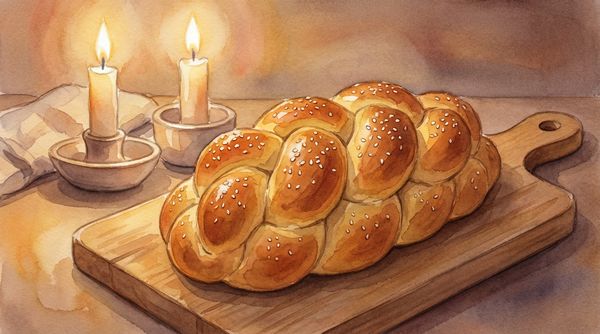
A traditional challah is made from six strands of dough, braided together into a loaf. The six-strand braid is taught by mothers to daughters, by grandmothers to grandchildren, by rabbis' wives to bat mitzvah girls, and by YouTube to everyone else. It looks complicated. It is — the first time. By the third Friday, your hands know the pattern without your mind's involvement: over two, under one, over two, under one. The rhythm is meditative in the way that all repetitive hand work is meditative. Your mind drifts. The strands cross. The loaf takes shape.
Some families do a three-strand braid — simpler, rounder, the kind a child can manage. Some do a round challah for Rosh Hashanah, the Jewish New Year, symbolising the cycle of the year. Some stuff it with raisins for sweetness in the year ahead. Some brush it with an egg wash so glossy it looks lacquered. Some sprinkle sesame seeds or poppy seeds. Some do both, because choosing is for other decisions.
The house fills with the smell while the challah bakes. If you have ever walked into a home on a Friday afternoon and been hit by the smell of challah in the oven, you understand something about Shabbat that no explanation can provide. The smell is the invitation. Come in. Sit down. The week is ending. This is the bread that says so.
Two challahs are placed on the Shabbat table. Two, because of the double portion of manna that fell in the desert on Fridays so the Israelites wouldn't have to gather food on the Sabbath. The challahs are covered with a cloth — traditionally, so they won't be "embarrassed" that the wine is blessed before them. This small, gentle courtesy extended to bread is one of the loveliest details in all of Jewish practice. Even the bread has feelings. Even the bread is considered.
The blessing is said. The cloth is lifted. The challah is torn — not cut, torn — and pieces are passed around the table. The first bite is warm if the timing was right, slightly sweet, soft inside with a thin golden crust. Someone says "good Shabbos." Someone else reaches for seconds. The week has turned.
The Cultural Moment
Challah has been part of Jewish Shabbat observance for centuries. The word itself comes from the biblical commandment to separate a small portion of dough as an offering — hafrashat challah — a practice still observed by many Jewish bakers, who pinch off a small piece of dough before braiding and set it aside (or burn it), reciting a blessing. The bread and the offering share a name, binding the act of baking to the act of giving.
The braided form is Ashkenazi — originating in the Jewish communities of Central and Eastern Europe, where enriched egg bread became the Shabbat standard. Sephardic and Mizrahi Jewish communities have their own Shabbat breads — kubaneh in Yemen, jachnun, various flatbreads — each with its own tradition and its own Friday rhythm. But the braided challah became the most widely recognised, carried across oceans by immigrants who packed recipes the way others packed photographs.
In the Jewish diaspora, challah baking became one of the ways identity survived. In new countries, in unfamiliar kitchens, with flour that behaved differently and ovens that ran too hot or too cold, Jewish women (and it was mostly women, for most of the history) baked challah on Fridays because the ritual itself was the anchor. The bread might taste slightly different in Buenos Aires than in Kraków than in Brooklyn. The act of making it was the same.
Today, challah has crossed beyond strictly observant homes. It appears in bakeries, at farmers' markets, in cooking classes, on Instagram. Non-Jewish bakers have discovered what Jewish grandmothers always knew: enriched egg bread is one of the best things you can make with your hands, and the braiding is the part that makes you slow down. In an era of bread machines and same-day delivery, challah stubbornly insists on being made by hand. The braiding cannot be automated. The shaping cannot be rushed. The rising takes the time it takes.
This is bread that teaches patience. And on Friday afternoon, when the rest of the week is still ringing in your ears, patience is exactly what the kitchen offers.
The Recipe
This is a classic Ashkenazi challah — six-strand braid, egg wash, the works. It makes two loaves because Shabbat requires two, and because one loaf is never enough.
Makes: 2 loaves
What you need: - 1 1/2 cups warm water (about 110°F / 43°C — warm enough that you can hold your finger in it comfortably, not so hot that you pull away) - 2 1/4 teaspoons active dry yeast (one standard packet) - 1/2 cup sugar, plus 1 teaspoon for the yeast - 1/2 cup vegetable oil (or mild olive oil) - 4 large eggs — 3 for the dough, 1 for the egg wash - 1 tablespoon salt - 6-7 cups all-purpose flour (start with 6, add as needed) - Sesame seeds or poppy seeds for topping (optional, but traditional)
What you do:
In a large bowl, combine the warm water, the teaspoon of sugar, and the yeast. Stir gently. Wait 5-10 minutes. The yeast should bloom — it will foam and bubble and smell like bread is already happening. If it doesn't, your water was too hot or your yeast was dead. Start again.
Add the remaining sugar, the oil, three eggs (lightly beaten), and the salt. Stir until combined.
Add the flour one cup at a time, stirring after each addition. When the dough becomes too thick to stir, turn it out onto a floured surface and knead. This is the meditative part. Push the dough away with the heel of your hand, fold it back, turn it a quarter. Repeat for 8-10 minutes. Add flour as needed — the dough should be smooth, elastic, and slightly tacky but not sticky. It should feel like something alive.
Place the dough in a large oiled bowl. Cover with a damp towel or plastic wrap. Let it rise in a warm place for 1 to 1.5 hours, until it doubles in size. The dough is ready when you press a finger into it and the dent stays.
Punch the dough down. This is satisfying in a way that has nothing to do with baking. Divide it in half — each half will become one loaf.
For each loaf: divide the half into six equal pieces. Roll each piece into a rope about 12-14 inches long and roughly even in thickness. Lay the six ropes side by side, pinch them together at the top, and braid.
The six-strand braid (it's easier than it looks once your hands learn it): - Number the strands 1 through 6, left to right. - Move strand 6 over strand 1. - Move strand 2 over strand 6. - Move strand 1 over strand 3. - Move strand 5 over strand 1. - Move strand 6 over strand 4. - Repeat from the top until you reach the end. Tuck the ends under.
If the six-strand feels impossible on your first try, do a three-strand braid instead. Nobody at the table will love you less.
Place both loaves on a parchment-lined baking sheet. Cover with a towel and let them rise for another 30-40 minutes. They'll puff up and look proud of themselves.
Preheat the oven to 350°F (175°C).
Beat the remaining egg with a tablespoon of water. Brush the loaves generously — every crevice, every braid. This is what gives challah its famous golden shine. Sprinkle with sesame or poppy seeds if using.
Bake for 25-30 minutes, until the loaves are deep golden brown and sound hollow when you tap the bottom. The smell will have filled the house approximately ten minutes ago.
Let them cool on a wire rack. Or don't. Challah warm from the oven, torn with your hands, eaten standing in the kitchen before Shabbat even starts — that's between you and the bread.
The Gathering Note
Challah is Friday bread. It arrives at the same time every week, which is part of its power. In a life where most things are unpredictable, the challah is always there. The yeast always rises. The braid always holds. The blessing is always the same words.
At the Shabbat table, the challah is torn and shared — never cut, because knives are instruments of work and Shabbat is the absence of work. You tear a piece and pass it. You tear a piece and eat it. The bread is soft and gives easily. It was made to be shared this way.
The braiding is the part that matters most during the making. Not because the pattern is important, but because the braiding is the moment you stop. Your hands are busy. Your mind is quiet. The week — all its noise, all its demands — begins to loosen its grip. By the time the loaves go into the oven, the turning has already begun. The bread just makes it visible.
Shabbat shalom. The week has turned. Pull up a chair.