🍳 Calentado — Yesterday's Dinner, This Morning's Grace
Colombia — and every kitchen where last night's rice got a second life at sunrise
The Story
The word means "warmed up." That's it. That's the whole name. Calentado. Yesterday's dinner, reheated for breakfast. In most of the world, leftovers are what you eat when you can't be bothered to cook. In Colombia, leftovers are what you eat when someone loved you enough to cook too much.
Calentado is not a recipe. It is a philosophy that says: nothing is wasted. Not the rice. Not the beans. Not the bit of meat from last night. Not the arepa that didn't get eaten. Not the plantain that's gone a little soft. Every leftover in the fridge is an ingredient for tomorrow morning, and tomorrow morning in a Colombian kitchen starts with a pan, some oil, and the quiet confidence of someone who knows that reheated food, done right, is better than the original.
This is not controversial in Colombia. This is just true.
The base is always rice and beans — the arroz and frijoles that appeared on last night's plate, now cold and stuck together in the container. Into the pan they go, with a splash of oil, and the heat does something that no fresh batch can replicate: it fries the edges of the rice, crisps the outside of the beans, creates a texture that is half-soft, half-crunchy, and entirely morning. The rice picks up the colour of the beans. The beans soften into the rice. They become one thing, and that one thing is breakfast.
But calentado is never just rice and beans. It's rice and beans plus whatever else was there. Shredded beef from last night's carne asada. A bit of chicharrón. Some hogao — the slow-cooked tomato and onion sauce that appears on every Colombian table the way salt appears on every other table. A slice of chorizo, if there was chorizo. A piece of morcilla, if someone's grandmother was involved.
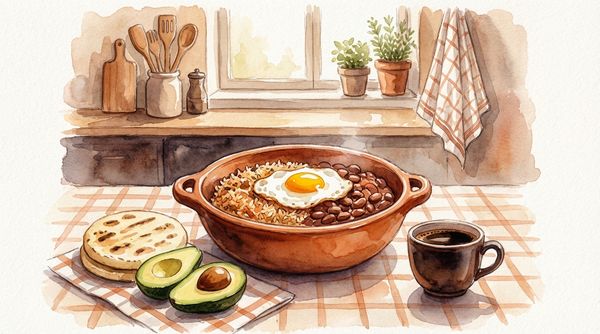
And then: an egg. Always an egg. Fried, with a runny yolk that breaks over the reheated everything and turns it into a meal that no restaurant could replicate because no restaurant has access to your family's specific combination of last night's dinner.
An arepa on the side. A cup of tinto — thin, sweet, black coffee served in a small cup, the Colombian answer to the British cup of tea. Not espresso. Not pour-over. Just coffee, the way your mother made it, too sweet and exactly right.
This is how Colombia wakes up. Not with something new. With something that was already loved, loved again.
The Cultural Moment
Calentado is the breakfast of the Zona Cafetera, the Andean highlands, the paisa culture of Antioquia and the Eje Cafetero — the coffee-growing region where the mornings are cool and the days are long and the work starts early. Farmers, coffee pickers, labourers — the people who built the backbone of Colombia's rural economy — ate calentado because it was practical. You cooked a large dinner. You ate what you could. The rest became morning.
But practicality is only half the story. The other half is something closer to reverence. In Colombian culture, food waste is a kind of sin. Not a religious one — a familial one. A paisa grandmother who sees food thrown away will look at you with the kind of quiet devastation that makes you rethink your entire life. The food was made with effort. The ingredients cost money. The hands that prepared it were tired. To waste it is to waste all of that. Calentado is the answer: nothing is wasted. Everything gets a second morning.
The dish also carries class in a way that Colombia has slowly reclaimed. For decades, calentado was "poor food" — the breakfast of people who couldn't afford fresh ingredients every morning. Urban elites in Bogotá ate bread and eggs and looked down on the reheated plate from the countryside. But the countryside didn't care. The countryside knew what was good. And eventually, the cities caught up. Today, calentado appears on brunch menus in Medellín and Bogotá, served on ceramic plates with a fried egg arranged just so. The farmers who invented it would probably laugh. They'd also eat it, because calentado is calentado regardless of the plate.
In the Colombian diaspora — in Queens, in Miami, in Madrid — calentado is the breakfast that makes a foreign kitchen feel like home. You can't buy it at a restaurant and have it taste right. It has to be made from your leftovers, in your pan, by you or someone who knows your kitchen. It's breakfast that carries the memory of last night's dinner, which carries the memory of the person who cooked it, which carries the memory of the person who taught them.
Every plate of calentado is at least two meals old. That's what gives it its depth.
The Recipe
This is not a recipe in the traditional sense. Calentado, by definition, is made from whatever you have. But here is the framework — the paisa version, the one that starts with rice and beans and becomes a morning.
Serves: 2-3 (calentado is a family breakfast, but a small family — it uses what's there)
What you need: - 2-3 cups leftover cooked rice (white rice, ideally made the Colombian way — with a little oil and salt, cooked until each grain is separate) - 1-2 cups leftover cooked beans (frijoles rojos — red kidney beans stewed with a sofrito of onion, tomato, garlic, and cumin, or frijoles paisas if you have them) - Leftover meat — whatever was served last night: shredded beef, ground beef, chicharrón, chorizo, or nothing at all - 2-3 tablespoons vegetable oil or butter - 2-3 eggs - Salt to taste
On the side (not optional, these are the side characters that make the scene): - Arepas — store-bought or homemade, grilled or fried, buttered - Hogao — slow-cooked sauce of diced tomatoes and white onion, softened in oil with a pinch of cumin and salt until everything collapses into sweetness (make this fresh if you don't have leftovers — it takes 15 minutes and transforms everything) - Ripe plantain (tajadas) — sliced on the diagonal and fried until golden and caramelised at the edges - Avocado — sliced, salted, just there - Tinto — black coffee, brewed strong, sweetened with panela or sugar
What you do:
Heat a large pan or skillet over medium-high heat. Add the oil. When it shimmers, add the leftover rice and beans together. Don't stir right away — let the bottom get a little crispy, a little golden. That crust is the whole point of calentado. After a minute or two, stir it through, let it sit again. You're building layers of texture: some soft, some crunchy, everything warm.
If you have leftover meat, add it now. Stir it through and let it heat with everything else. The flavours from last night will deepen — the cumin in the beans, the garlic in the meat, the salt that's been sitting and settling overnight.
Taste. Add salt if needed. The overnight rest concentrates flavours, so you might not need much.
Push the calentado to one side of the pan, or move it to plates. In the same pan (or a separate one), fry the eggs. Sunny side up, yolk runny. This is not negotiable. The yolk is the sauce.
Plate the calentado. Egg on top. Hogao spooned beside it. Arepa on the side. Plantain if you have it. Avocado because it's Colombia and avocado is a fundamental right.
Pour the tinto. Sit at the table. Eat slowly. The morning is not in a hurry, and neither is this plate.
The Gathering Note
Calentado is not gathering food — it's family food. The small gathering. The two or three people who were here last night and are here again this morning. It's the breakfast that says: we ate together yesterday, and we'll eat together today, and the food connects the two days like a thread.
In Colombian homes, the person who makes calentado in the morning is often the person who cooked dinner the night before. They're finishing what they started. The meal isn't over until the leftovers are gone, and the leftovers aren't gone until they've been reheated with love and an egg cracked on top.
Nothing is wasted. Nothing is over. Yesterday's dinner, this morning's grace.