🇯🇲 Ackee & Saltfish — The National Dish at the National Hour
Jamaica — and every yard, veranda, and kitchen abroad where the morning smells like home
The Story
Sunday morning in Jamaica doesn't start with an alarm. It starts with a sound — a pan heating, oil popping, and the particular sizzle of saltfish hitting hot metal. Then comes the smell: scotch bonnet, thyme, onion, and the soft, buttery sweetness of ackee that has no equivalent anywhere else on earth. If you grew up in a Jamaican household, this smell is not breakfast. It is geography. It is Sunday. It is home reduced to a single sense.
Ackee is a strange and beautiful fruit. It grows on trees all over Jamaica — brilliant red pods that split open when ripe to reveal three glossy black seeds cradled in bright yellow flesh that looks, when cooked, almost exactly like scrambled eggs. It has a mild, creamy, faintly nutty flavour that absorbs whatever it's cooked with. On its own, it's subtle. With saltfish, it becomes something that two hundred years of Jamaican mornings have agreed is the perfect plate.
The saltfish is cod — dried, salted, preserved. It came to the Caribbean on trade ships centuries ago, cheap protein for enslaved people who were given the food the colonisers didn't want. What they did with it was alchemy. They soaked it overnight to pull the salt out, then flaked it and cooked it with whatever the island gave them — ackee from the trees, scotch bonnet from the garden, thyme growing wild. The dish that emerged from that forced scarcity became the national dish of Jamaica. Not by government decree (though it has that too), but by consensus. By every grandmother. By every Sunday.
The preparation is not complicated, but it is specific. The saltfish must be soaked — ideally overnight, at minimum for a few hours with several changes of water. Rush this and the dish is inedibly salty. The ackee must be handled gently — it's soft, almost fragile, and if you stir it too aggressively it turns to mush. The scotch bonnet goes in whole or barely nicked — you want its flavour, its perfume, not its full heat (unless you do, in which case chop it fine and accept the consequences). The thyme is fresh, pulled from the stem, because dried thyme is for emergencies and this is not an emergency. This is Sunday.
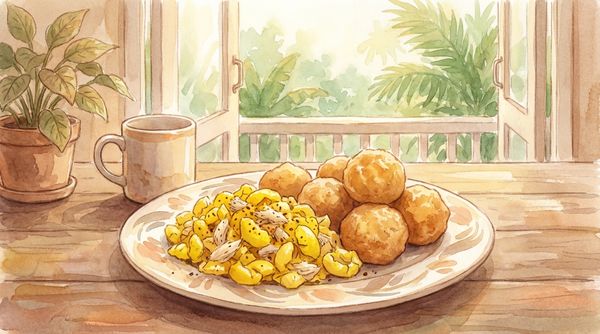
The plate comes together quickly once everything is prepped. The saltfish goes into the pan first with onions, peppers, tomatoes. Then the ackee folds in at the end, just long enough to warm through. It's served with fried dumplings — johnny cakes — or boiled green bananas, or breadfruit roasted until the outside chars and the inside turns to something between potato and cloud. A cup of bush tea or Blue Mountain coffee. The veranda if there is one. The kitchen table if there isn't.
This is how Jamaica wakes up. Not fast. Not fancy. Just right.
The Cultural Moment
Ackee arrived in Jamaica from West Africa in the 18th century, likely on a slave ship. The tree is native to the forests of Ghana, Côte d'Ivoire, and surrounding countries, where the fruit is called ankye or akye. Its botanical name — Blighia sapida — comes from Captain William Bligh, who transported specimens to England in 1793. The fact that a fruit central to Jamaican identity carries the name of an English naval captain is the kind of colonial irony Jamaica has learned to hold without flinching.
The fruit took to Jamaican soil like it had been waiting. Trees grow everywhere on the island — in yards, along roads, on hillsides. Ackee season peaks from January through March and again in the summer, and during peak season the trees are so loaded with red pods that the ground beneath them is carpeted in fruit. Neighbours share. Nobody buys ackee when someone on the street has a tree.
Ackee is also, in its unripe state, toxic. The unripe fruit contains hypoglycin, which causes what is clinically called "Jamaican vomiting sickness" and what Jamaicans call a very good reason to wait until the pods open on their own. Ripe ackee — pods that have split naturally on the tree — is perfectly safe. The rule is simple and absolute: if the pod hasn't opened, don't touch it. Every Jamaican child learns this. It is one of the first lessons of the kitchen.
In the Jamaican diaspora — in London, Toronto, New York, Miami — ackee and saltfish is the dish that bridges the distance. Tinned ackee (which is how most of the diaspora accesses it, since the fresh fruit is perishable and import-restricted in some countries) is a staple of Caribbean grocery stores. The tin is not the tree, but the tin is still Sunday. Jamaicans abroad will tell you their version is close. Then they'll pause and admit, quietly, that it's not quite the same. The ackee from the tree in the yard, picked that morning, cooked within the hour — that's different. That's home.
Ackee and saltfish appears at every Jamaican milestone. Weddings. Funerals. Christenings. Independence Day celebrations on August 6th. The dish is Jamaica in edible form — African fruit, European preserved fish, Caribbean seasoning, cooked by the descendants of enslaved people who made something national out of what was given as ration.
The Recipe
This is the classic preparation — ackee and saltfish as it's made in kitchens across Jamaica on any given Sunday. If you can get fresh ackee, use it. If not, tinned ackee from a Caribbean grocery store works well — just drain it gently.
Serves: 3-4
What you need: - 1 lb salt cod (boneless if you can find it — otherwise you'll be picking bones, which is fine, everyone does it) - 1 tin of ackee (about 540ml / 19oz), drained gently — or 12-15 fresh ackee arils if you're blessed with a tree - 2 tablespoons coconut oil or vegetable oil - 1 medium onion, sliced - 1 small red bell pepper, sliced - 1 small green bell pepper, sliced - 2 cloves garlic, minced - 2 medium tomatoes, diced - 1 whole scotch bonnet pepper (do not chop unless you want serious heat — leave it whole for flavour, pierced once with a knife) - 3-4 sprigs fresh thyme (or 1 teaspoon dried if fresh isn't available, but fresh is the standard) - 2 stalks of scallion (green onion), chopped - Black pepper to taste - Salt — taste first, the fish brings its own
On the side: - Fried dumplings (johnny cakes) — mix 2 cups flour, 1 tsp baking powder, pinch of salt, 1 tbsp butter, enough water to make a firm dough. Shape into small rounds, flatten slightly, fry in oil until golden on both sides. They should be crisp outside, soft inside. - Or: boiled green bananas, or roasted breadfruit, or hard dough bread, toasted and buttered - Bush tea (lemongrass, cerasee, or mint) or strong Jamaican Blue Mountain coffee
What you do:
The night before: put the salt cod in a large bowl, cover with cold water, and refrigerate overnight. Change the water once or twice if you remember. This pulls the excess salt out. In the morning, drain the fish, put it in a pot, cover with fresh water, and bring to a boil for 15-20 minutes. Drain again. When it's cool enough to handle, flake it with your fingers — pull it apart along the grain into bite-sized pieces. Remove any bones and skin. Set aside.
Heat the oil in a large skillet over medium heat. Add the onion, bell peppers, garlic, and scallion. Sauté for 3-4 minutes until everything softens and the kitchen begins to smell like a Jamaican Sunday.
Add the tomatoes, the whole scotch bonnet, and the thyme sprigs. Cook for another 2-3 minutes. The tomatoes should break down slightly. The scotch bonnet should be releasing its perfume into the pan without splitting open (handle it gently — one breach and the heat escapes into the whole dish).
Add the flaked saltfish. Stir gently. Let it cook with the vegetables for 3-4 minutes so the flavours marry.
Now the ackee. Add it to the pan and fold it in gently — use a wooden spoon or spatula, not a vigorous stir. The ackee is delicate. It will break apart if you're rough with it. You want the pieces to stay mostly intact, nestled among the saltfish and vegetables like yellow pillows.
Cook for 2-3 more minutes, just until the ackee is heated through. Taste. Add black pepper. You likely won't need salt — the fish remembers.
Remove the scotch bonnet (if it's still intact) and the thyme stems. Serve immediately.
The Gathering Note
Ackee and saltfish is Sunday morning food, but "Sunday morning" in Jamaica is not a time. It is a feeling. It is the pace of a day that hasn't decided what it's going to be yet. The kitchen is warm. Someone is frying dumplings. Someone else is on the veranda with a cup of coffee that's too strong and too sweet. The radio might be on. The birds are definitely on.
The plate arrives and it's yellow and bright and smells like the island smells when the morning is still cool and the day is still open. You eat with your hands if you're having it with dumplings. You eat slowly because the morning isn't going anywhere and neither are you.
For Jamaicans abroad, making ackee and saltfish on a Sunday is not cooking. It is wayfinding. It is the smell that makes a London flat or a Toronto apartment temporarily, unmistakably, home. The dish carries the whole island — the African tree, the colonial fish, the Caribbean fire, the Sunday morning pace that no other country quite manages to replicate.
Pull up a chair. The morning is here.